
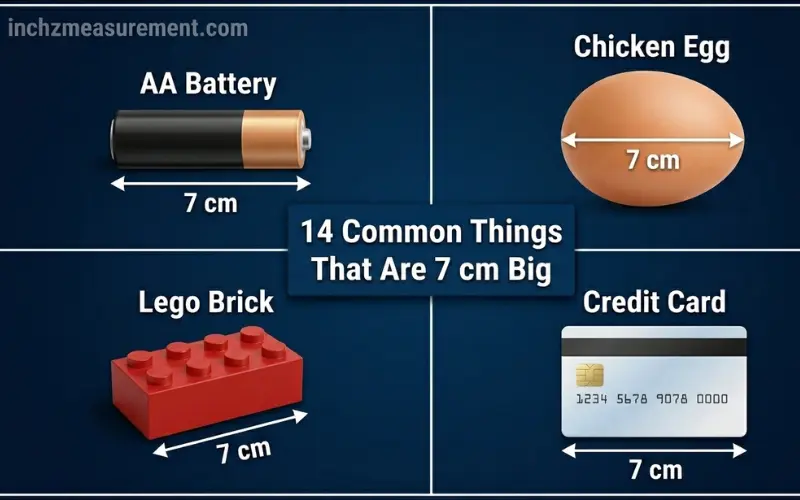
How Big Is 7 cm? Seven centimeters equals 70 millimeters, 2.756 inches, or 0.07 meters. Because a number alone can be difficult to picture, comparing 7 cm with familiar objects gives you a much clearer sense of its actual size. This guide covers 14 common objects that are about 7 cm, along with 7 cm in inches, 7 cm in mm, how big 7 cm looks visually, and how to measure 7 cm on a ruler.
How Big Is 7 cm in Inches?
]7 cm is approximately 2.756 inches, so it is a little more than 2¾ inches. On an inch ruler, the 7 cm point falls between 2¾ inches and 2⅞ inches.
This conversion is useful when a product description uses centimeters but you’re more comfortable with inches. For example, an item listed as 7 cm wide is just under 3 inches wide.
7 cm Conversion Table
| Measurement | Equivalent |
| Millimeters | 70 mm |
| Centimeters | 7 cm |
| Inches | 2.756 inches |
| Feet | 0.2297 ft |
| Meters | 0.07 m |
The conversion is exact before rounding because 1 inch equals 2.54 cm. Dividing 7 by 2.54 gives approximately 2.7559 inches, which is normally displayed as 2.756 inches.
How Big Is 7 cm in mm?
7 cm equals 70 mm. Since every centimeter contains 10 millimeters, multiplying 7 by 10 gives 70.
The relationship is:
7 cm × 10 = 70 mm
So if a manufacturer lists a component as 70 mm long, that is exactly the same measurement as 7 cm.
How Big Is 7 cm Visually?
A measurement of 7 cm is roughly the length or diameter of several familiar items, although exact dimensions vary. A tennis ball, a U.S. dollar bill’s shorter dimension, and some standard stationery items can all help you build a mental picture of this size.
The most useful comparisons are objects with standardized or commonly documented dimensions. The examples below are arranged with close matches first.
14 Common Objects That Are About 7 cm
Trying to picture 7 cm without a measuring tool can be difficult because the number itself does not show you the physical size. At 70 mm or approximately 2.756 inches, 7 cm is a little shorter than 3 inches. The 14 everyday comparisons below—from a tennis ball and baseball to stationery, craft supplies, and small household items—give you different ways to visualize this measurement. Exact dimensions can vary between products, so each example is presented as an approximate comparison rather than an absolute size.
1. Tennis Ball
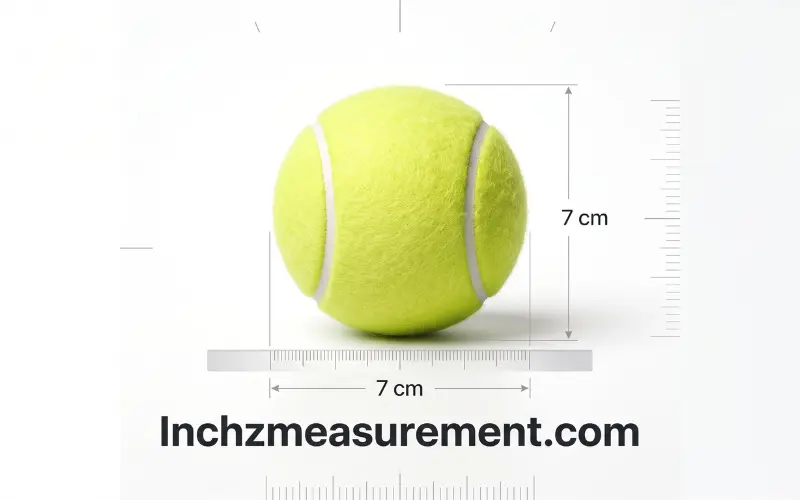
A standard tennis ball has a diameter of approximately 67 mm, or 6.7 cm. That puts it only about 3 mm below the 7 cm target, making it one of the closest familiar spherical comparisons.
If you picture a tennis ball from one side straight across to the other, you’re looking at almost exactly 7 cm. Tennis balls are standardized within a specified size range, so their diameter is much more predictable than that of many household objects.
2. Baseball
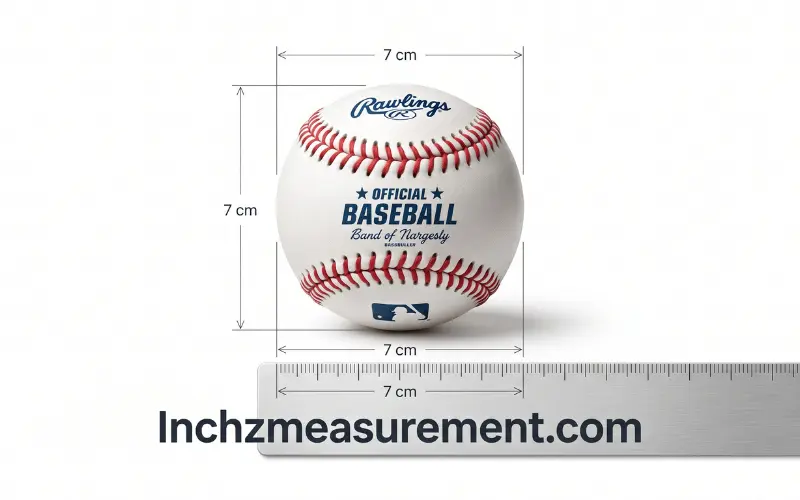
A regulation baseball measures roughly 73 mm in diameter, which is 7.3 cm. It is therefore about 3 mm larger than 7 cm.
The difference is small enough that a baseball gives a useful sense of the target size, especially when thinking about diameter rather than length. Its familiar shape also makes it easy to visualize how wide a 7 cm circle would appear.
3. U.S. Dollar Bill Width
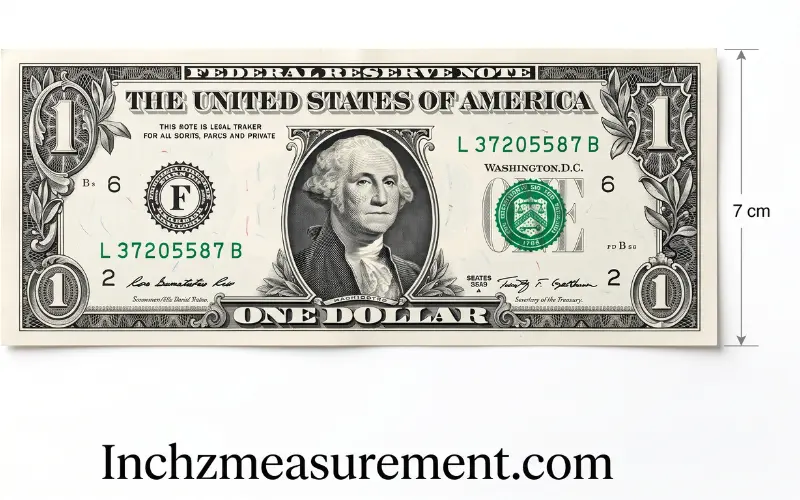
A U.S. dollar bill measures 66.3 mm wide, or 6.63 cm. Its width is approximately 3.7 mm less than 7 cm.
Place the shorter side of a dollar bill against a ruler and the distance is surprisingly close to the 7 cm mark. This comparison is especially useful because the dimensions of U.S. currency are standardized.
4. 3-Inch Sticky Note
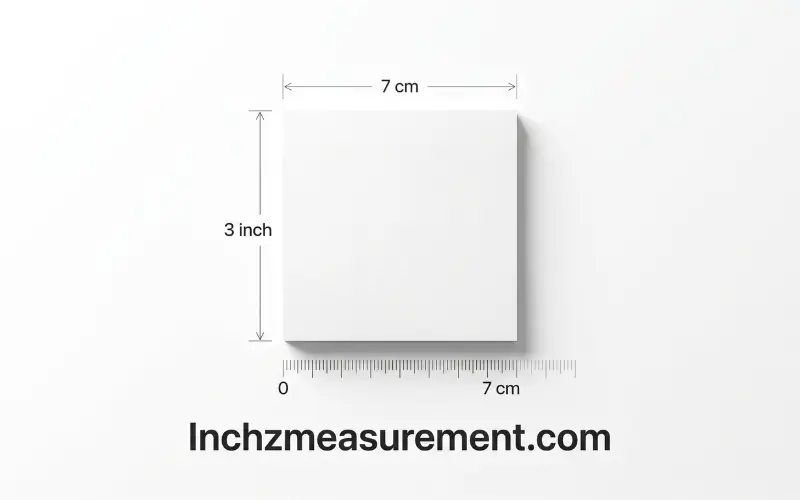
A standard 3 × 3 inch sticky note has a side length of 76.2 mm, or 7.62 cm. Its side is therefore about 6.2 mm longer than 7 cm.
The difference is easy to account for visually. Looking across one side of a common square sticky note gives you a slightly larger measurement than 7 cm.
5. Standard Index Card Width
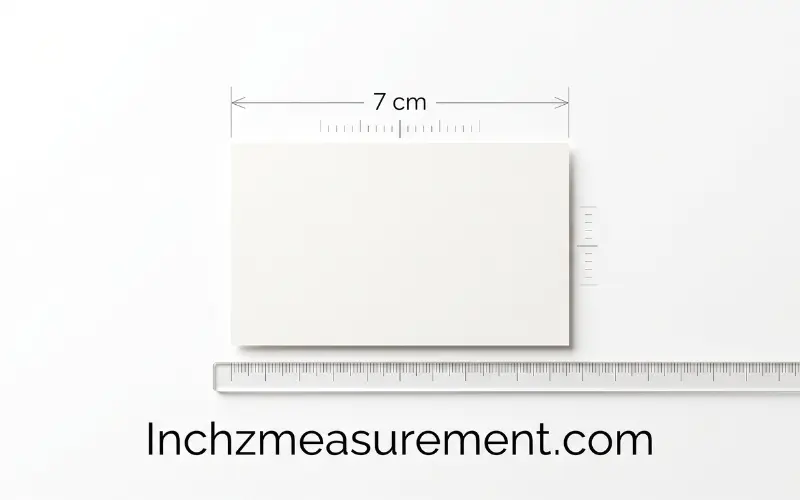
A common 3 × 5 inch index card has a shorter dimension of 3 inches, equivalent to 7.62 cm. That side is only 6.2 mm longer than the target.
Index cards are widely used for studying, organizing notes, and presentations. Their standardized dimensions make the 3-inch width a convenient comparison when estimating a 7 cm measurement.
6. Wooden Clothespin
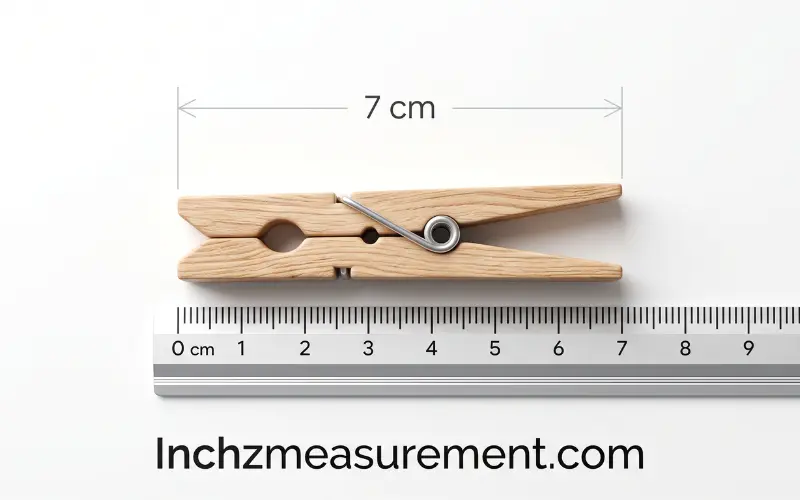
Many traditional wooden clothespins measure around 70–75 mm long, depending on their design. A model measuring 70 mm is exactly 7 cm from end to end.
Because clothespins are compact and easy to handle, they provide a particularly straightforward way to imagine this length. Designs differ, so measuring the specific clothespin is best when precision matters.
7. Long Golf Tee
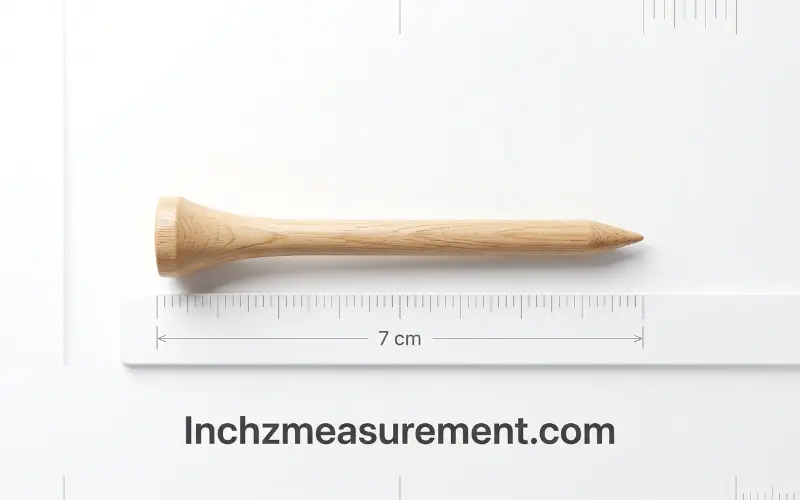
Long golf tees are commonly manufactured at lengths around 70 mm. A 70 mm tee has a total length of exactly 7 cm.
This comparison works particularly well because the measurement refers to the complete length rather than the width. Different tee styles come in several lengths, so check the package dimensions if you need an exact 7 cm example.
8. Small USB Flash Drive
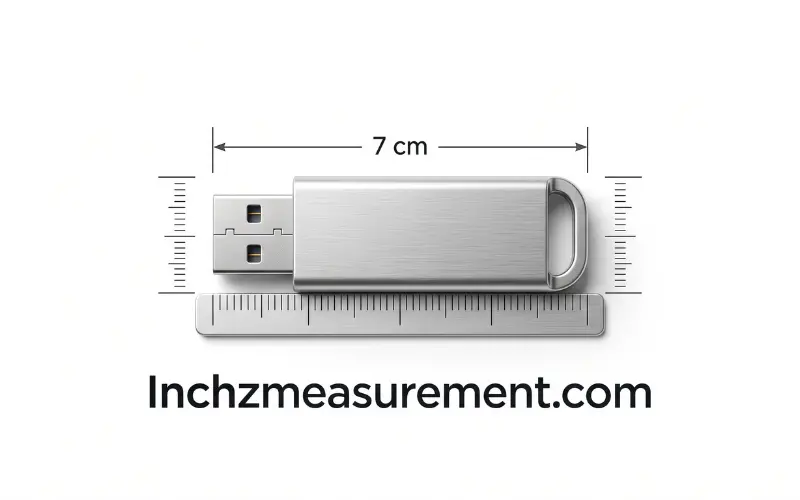
Some compact USB flash drives have a body length close to 70 mm, although designs vary considerably between manufacturers.
A flash drive measuring 70 mm from end to end would match 7 cm exactly. This is a useful example for understanding why product specifications should always be checked rather than assuming every USB drive has the same dimensions.
9. Small Key Fob
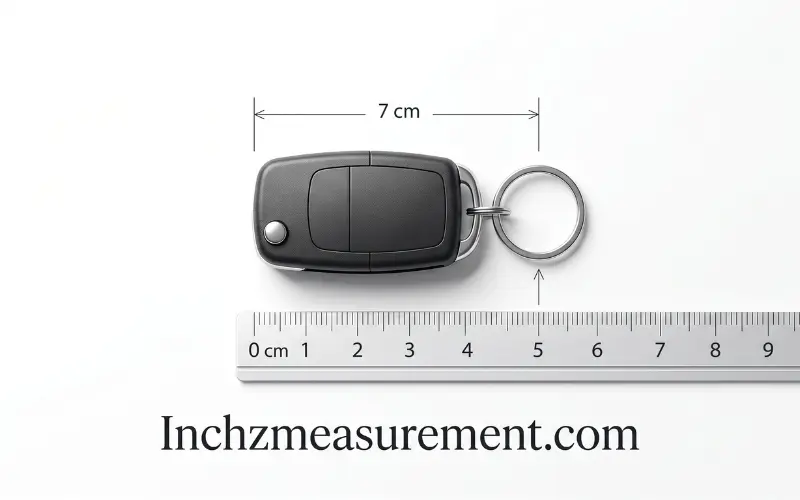
Some compact key fobs measure around 65–75 mm along their longest side. A model at 70 mm would be exactly 7 cm long.
Unlike standardized objects such as currency, key fobs come in many shapes and sizes. Treat this as an approximate visual comparison rather than a fixed measurement.
10. Small Toy Car
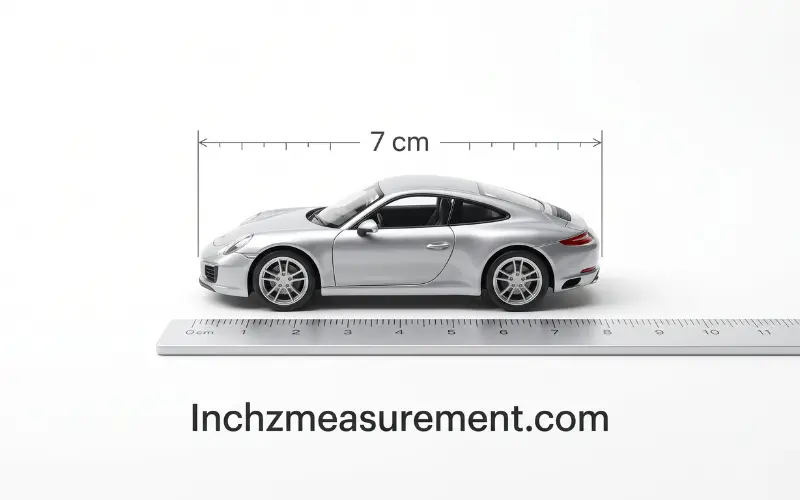
Many miniature toy cars are produced in different scales, with some compact models measuring around 70 mm long.
A toy car that measures 7 cm from its front bumper to its rear edge gives you a familiar horizontal comparison. Because toy sizes vary by scale, the packaging or manufacturer’s specifications should be checked for an exact dimension.
11. Small Pocket Comb
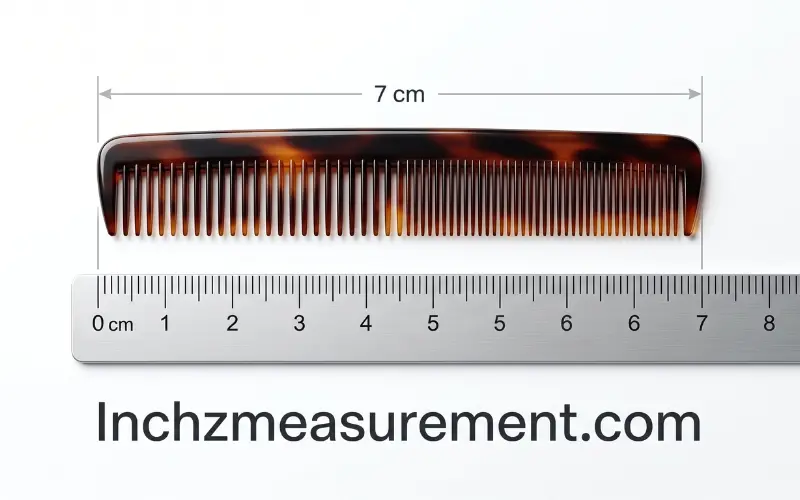
Compact pocket combs can measure roughly 65–75 mm long, depending on the style and folding mechanism.
A straight pocket comb measuring 70 mm would be precisely 7 cm long. Its narrow shape also demonstrates that a measurement can describe length even when the object itself is much narrower.
12. Mini Ruler Section
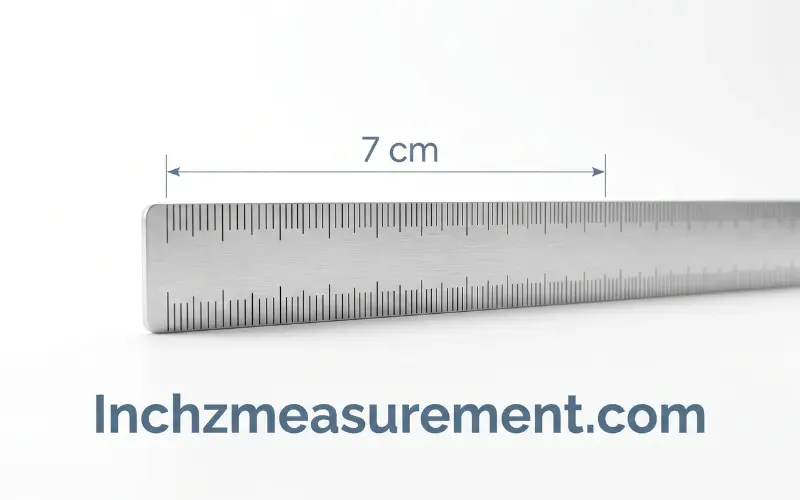
A ruler naturally provides the most direct way to understand this measurement. The distance from the 0 cm mark to the 7 cm mark is exactly 7 cm, or 70 mm.
Although a ruler is technically a measuring instrument rather than an everyday object comparison, it removes uncertainty. If you need to verify any of the other examples, this is the simplest method.
13. Small Craft Ribbon Width
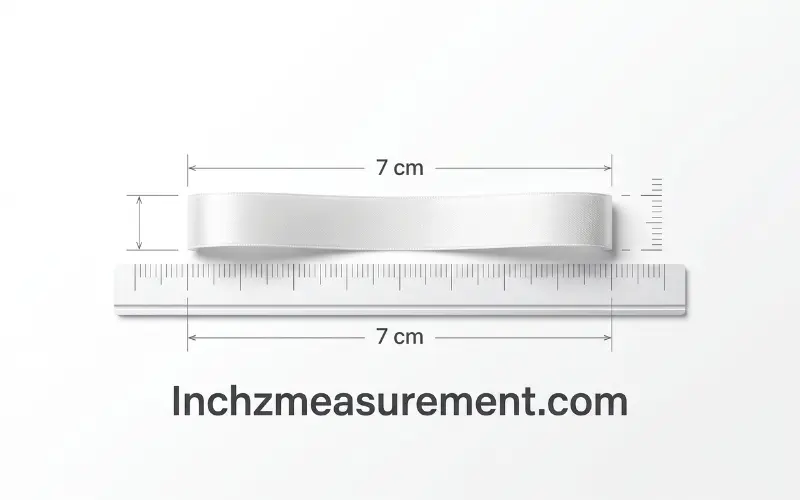
Some narrow craft ribbons are sold in widths around 70 mm, particularly decorative trims and specialty ribbon products.
A 70 mm ribbon is exactly 7 cm wide. Ribbon comes in many widths, however, so this example should be treated as a product-specific comparison rather than a universal dimension.
14. Small Decorative Wooden Block
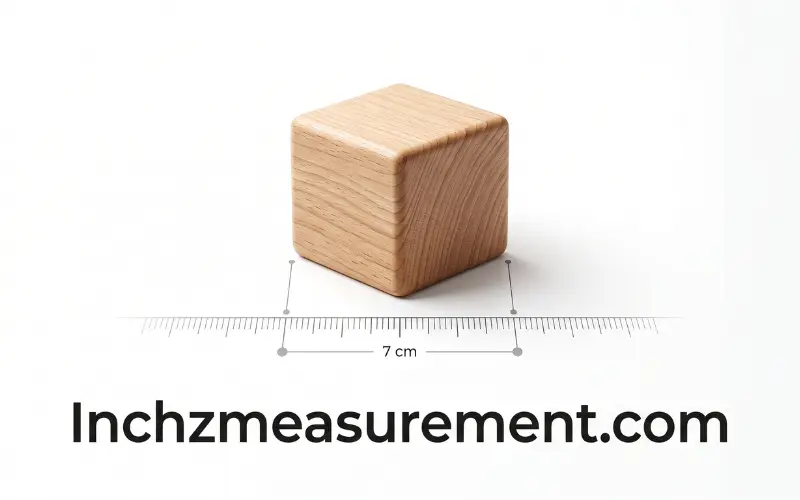
Some craft and educational wooden blocks are manufactured with dimensions close to 70 mm on one side.
A block with a 70 mm side measures exactly 7 cm along that edge. Because wooden blocks are sold in many different sizes, check the listed dimensions before using one as a precise measuring reference.
Quick Comparison Table
| Object | Approximate Measurement | Closeness to 7 cm |
| Tennis ball | 67 mm | Very Close |
| U.S. dollar bill width | 66.3 mm | Very Close |
| Baseball | 73 mm | Very Close |
| Wooden clothespin | 70–75 mm | Exact to Very Close |
| Long golf tee | ~70 mm | Exact |
| 3-inch sticky note | 76.2 mm | Slightly Larger |
| 3 × 5 inch index card width | 76.2 mm | Slightly Larger |
| Small USB drive | ~70 mm | Exact on some models |
| Small key fob | 65–75 mm | Very Close |
| Small toy car | ~70 mm | Exact on some models |
| Pocket comb | 65–75 mm | Very Close |
| Ruler 0–7 cm section | 70 mm | Exact |
| Craft ribbon | ~70 mm | Exact on some products |
| Small wooden block | ~70 mm | Exact on some models |
How Big Is 7 cm on a Ruler?
To find 7 cm on a ruler, start at the zero mark and move to the line labeled 7 cm. The distance between those two points is 70 mm.
On an imperial ruler, the same distance is approximately 2.756 inches. It falls just beyond the 2¾-inch mark, which equals 2.75 inches.
This is an important distinction: 7 cm is not exactly 2¾ inches. The difference is small, but precision matters when measuring materials, designing parts, or following instructions.
How Big Is 7 cm in Diameter?
When something has a 7 cm diameter, it measures 70 mm straight across its center, from one edge to the opposite edge.
The radius is half the diameter:
- Diameter: 7 cm
- Diameter: 70 mm
- Diameter: 2.756 inches
- Radius: 3.5 cm
A tennis ball is slightly smaller at about 6.7 cm across, while a baseball is slightly larger at about 7.3 cm. Together, they give you a useful sense of the size of a 7 cm circle.
How Big Is 7 cm by 7 cm?
A 7 cm by 7 cm square has two sides measuring 7 cm each. Its area is:
7 cm × 7 cm = 49 cm²
In millimeters, the same square is 70 mm × 70 mm. This is useful when working with fabric, paper, tiles, labels, artwork, or craft materials.
The phrase 7 cm x 7 cm describes the dimensions of the square, not its area. The area is 49 square centimeters.
How Big Is 7 cm Round?
When an object is described as 7 cm round, it commonly means its diameter is approximately 7 cm, although product descriptions can use “round” differently.
A 7 cm round object would measure 70 mm across its widest point through the center. A tennis ball is close to this size, while a baseball is slightly larger.
Why Does 7 cm Matter?
In professional settings, measurements around 7 cm can appear in product design, manufacturing, packaging, woodworking, engineering, and technical drawings. A difference of only a few millimeters can affect whether a component fits properly, so converting between centimeters, millimeters, and inches accurately is important.
For everyday tasks, 7 cm can help when comparing online product dimensions, cutting craft materials, checking furniture hardware, or estimating the size of a small object. Knowing that 7 cm is about 2.756 inches gives you a quick way to switch between metric and imperial measurements.
Related
- How Long Is 6 Feet?
- How Long Is 8 Feet?
- How Long Is 9 Feet?
- How Long Is 12 Feet?
- How Long Is 2 Feet?
- How Long Is 5 Feet?
FAQs
Is 7 cm the same as 70 mm?
Yes. 7 cm equals exactly 70 mm because each centimeter contains 10 millimeters.
How many inches is 7 cm?
7 cm is approximately 2.756 inches. It is slightly larger than 2¾ inches.
Is 7 cm close to 3 inches?
Yes, but they are not identical. 3 inches equals 7.62 cm, so 7 cm is 0.62 cm, or 6.2 mm, shorter.
How do I measure 7 cm without a ruler?
You can estimate it using a tennis ball’s diameter, a U.S. dollar bill’s width, or another close object from the comparison list. For an exact measurement, however, a ruler or measuring tape is preferable.
How big is 7 cm visually?
A 7 cm measurement is roughly comparable to the diameter of a tennis ball, although a tennis ball is slightly smaller at about 6.7 cm. A baseball is slightly larger at around 7.3 cm.
How big is 7 cm in mm?
7 cm is 70 mm. This is an exact metric conversion.
Is 7 cm the same as 2.75 inches?
No. 2.75 inches equals 6.985 cm, which is about 0.015 cm shorter than 7 cm. The two measurements are extremely close, but they are not mathematically identical.
What is 7 cm in feet?
7 cm is approximately 0.2297 feet. It is much less than one foot.
Conclusion
How Big Is 7 cm? It measures 70 mm, approximately 2.756 inches, and 0.07 meters. For a quick visual estimate, a tennis ball at about 6.7 cm and a baseball at about 7.3 cm bracket the target from either side, while a 70 mm ruler section gives you the exact distance.
Once you know the relationship between centimeters, millimeters, and inches, measurements such as 7 cm become much easier to interpret. Whether you’re checking a product specification, working on a craft project, or simply trying to picture a dimension, these comparisons give you a practical starting point without sacrificing numerical accuracy.