
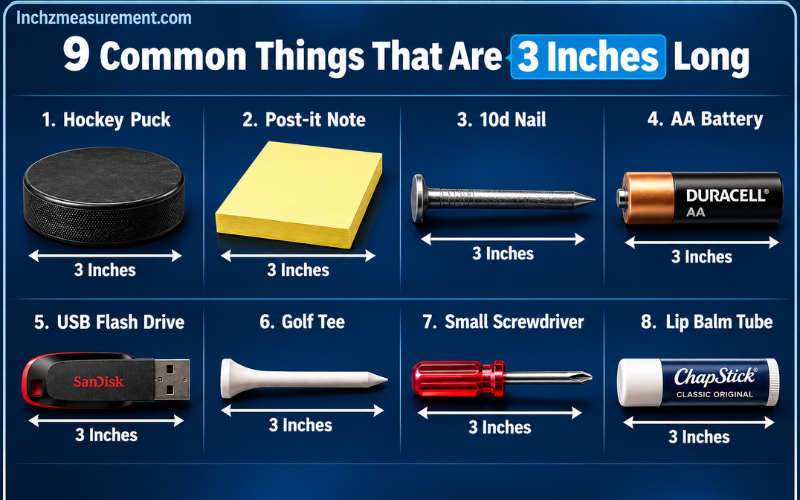
When you’re planning a small DIY project, checking a space on a shelf, or deciding whether something will fit through a narrow opening, 3 inches can be surprisingly hard to picture. A number on paper does not give you much of a visual unless you already have a strong sense of the measurement.
Real objects make the size easier to understand. A regulation hockey puck, a 3-inch sticky note, and a standard 10d common nail all give you something physical to picture.
Below, you’ll find exact 3-inch references backed by published specifications, followed by conversion tables, practical comparisons, and three methods for estimating 3 inches when you do not have a tape measure.
How Long Is 3 Inches?
3 inches = 0.25 feet
3 inches = 7.62 centimeters
3 inches = 0.0762 meters
3 inches = 0.0833 yards
3 inches = 76.2 millimeters
Three inches is exactly one-quarter of a foot. In metric units, it is exactly 7.62 centimeters or 76.2 millimeters.
The most useful mental shortcut is simple: picture the straight-line distance across a regulation hockey puck or the edge of a 3-by-3-inch sticky note. Those are much better exact references than objects that merely happen to be close to three inches.
Conversion Table
| Unit | Exact Equivalent |
| Inches | 3 inches |
| Feet | 0.25 ft |
| Centimeters | 7.62 cm |
| Millimeters | 76.2 mm |
| Meters | 0.0762 m |
| Yards | 0.0833 yd |
The inch and foot measurements are especially useful in the United States, while centimeters and millimeters are common in metric countries; engineers and technical workers may switch between both systems when precision matters.
Related Post: 10 Everyday Objects That Are About 2 Inches
What Does 3 Inches Look Like?
Three inches is not a large distance. On a standard 12-inch ruler, it takes up exactly one-quarter of the ruler’s total length. That means the distance from zero to the 3-inch mark is the visual target you are trying to recognize.
Another useful mental picture is a square 3-by-3-inch sticky note. The entire side is three inches, so you can see both the length and the width at the same time. 3M lists its classic Post-it Notes in a 3-by-3-inch format.
For an outdoor comparison, imagine the first few inches of a driveway, curb, or garden edging. Three inches is much shorter than a normal walking step. It is a compact distance that you can cover with part of your hand rather than a full arm movement.
9 Things That Are Exactly 3 Inches Long
When you need to picture 3 inches without reaching for a ruler, familiar objects can make the measurement much easier to understand. A regulation hockey puck, a 3 × 3-inch sticky note, and a 10d common nail each provide a clear physical reference for this short distance. In this section, we’ll look at 9 things that are exactly 3 inches long and explain where you can see each one in everyday life. These examples give you practical ways to picture how long 3 inches is and make the measurement easier to remember.
1. Regulation Hockey Puck — 3 Inches in Diameter
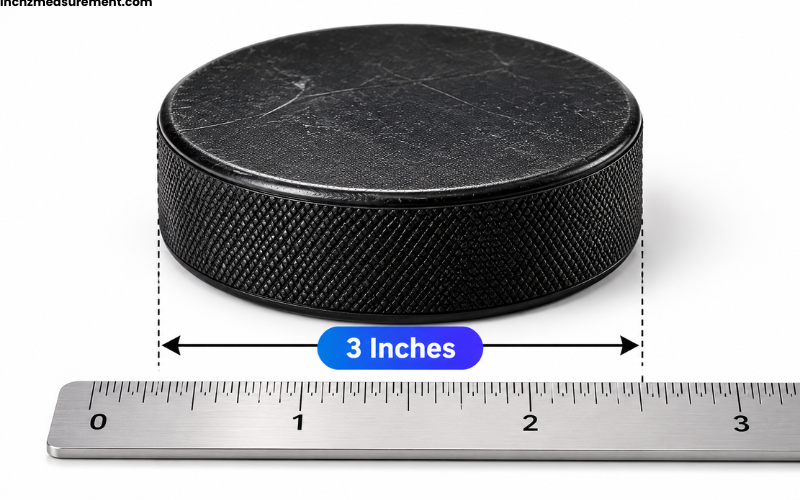
A regulation ice hockey puck has an official diameter of 3 inches. The International Ice Hockey Federation specifies a puck diameter of 7.6 cm and a thickness of 2.5 cm, while its public explanation gives the diameter as exactly 3 inches.
You can see this object during professional hockey games, recreational matches, hockey practices, and training sessions. It is a flat black disk made from vulcanized rubber.
Held in your hand, the puck feels dense and surprisingly substantial for its size. Looking straight at its circular face gives you a clean visual representation of three inches from one edge to the other.
That makes the hockey puck one of the strongest answers to how big is 3 inches because its playing specification is controlled by an international sports rule rather than being a random product dimension.
If you want one sports reference for a 3 inch example, the regulation hockey puck is the clearest choice.
2. A Standard 3 × 3-Inch Post-it Note — 3 Inches on Each Side
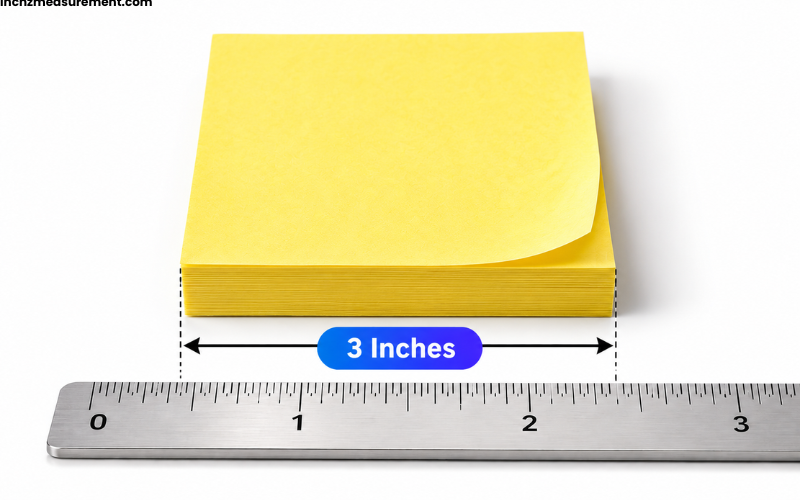
The classic square Post-it Note provides another exact 3-inch reference. 3M lists its Post-it Notes in a 3-by-3-inch format, giving each side a stated length of 3 inches.
You see these notes on desks, classroom walls, planners, calendars, office boards, refrigerators, and notebooks. Their square shape makes the measurement particularly easy to understand.
When you hold one in front of you, the three-inch edge feels short but clearly visible. You can place your finger at one corner and move it across the paper to get a physical sense of the distance.
The advantage is that you can see three inches in two directions at once. One side answers how long is three inches, while the adjacent side shows the same measurement vertically.
For an everyday 3 inch example, a genuine 3-by-3-inch Post-it Note is one of the easiest references to recognize.
3. A 10d Common Nail — Exactly 3 Inches Long
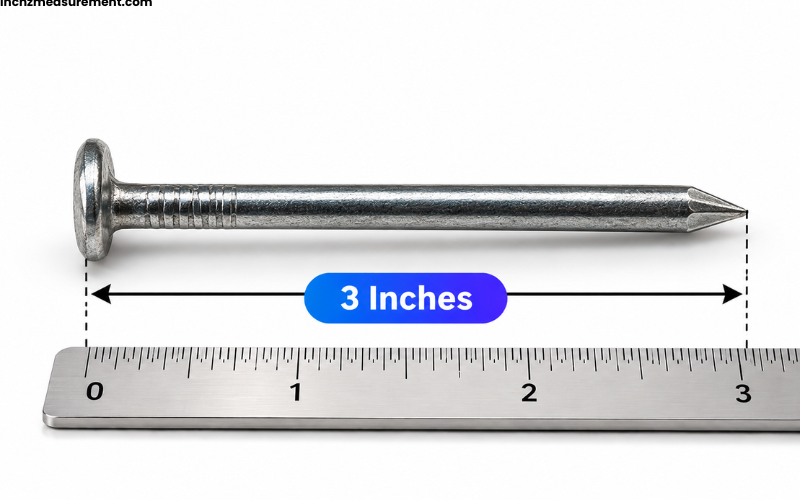
A 10d common nail is defined as 3 inches long. Construction references identify the 10d common nail as a 3-inch fastener, with structural references tying the dimension to ASTM F1667 specifications.
You would see these nails in construction sites, framing work, carpentry shops, hardware stores, and toolboxes. They are used for wood framing and other construction applications.
A nail is narrow, so it does not look large when you see it lying on a workbench. Pick it up and hold it lengthwise, though, and the full three-inch distance becomes much easier to judge.
The nail is especially useful for understanding the difference between length and thickness. The shaft is only a fraction of an inch wide, but its tip-to-head length is exactly three inches under the 10d common specification.
If someone asks what object is 3 inches long, a properly specified 10d common nail is a strong construction-related answer.
4. A 3-Inch-High Commercial Parcel — USPS Minimum Height
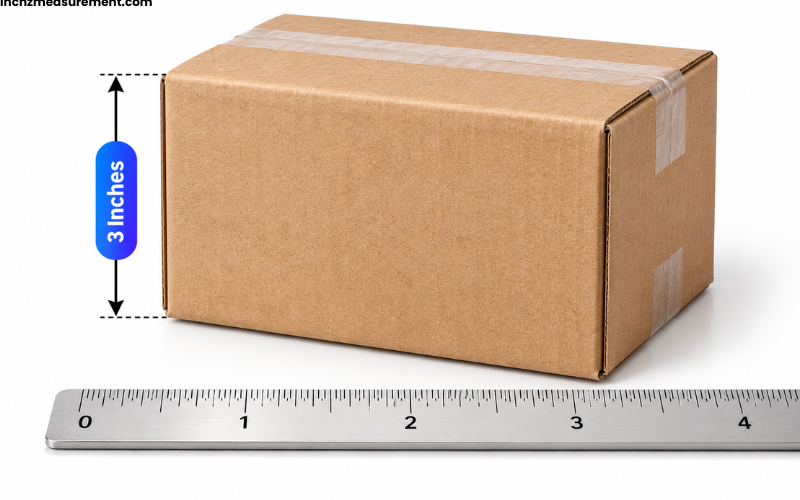
The United States Postal Service gives commercial parcels a minimum dimension of 3 inches in height, along with a minimum length of 6 inches and minimum thickness of one-quarter inch.
You encounter parcels at post offices, shipping counters, warehouses, mailrooms, and delivery locations. The important point here is that the three-inch measurement is an official dimensional requirement rather than an estimated size.
A box standing three inches high looks low when placed on a desk. You can easily see the difference between its three-inch vertical height and its six-inch minimum length.
This reference is useful because it turns an abstract measurement into a familiar shipping dimension. If you have a qualifying commercial parcel, its specified minimum height gives you a concrete way to picture three inches.
So, when thinking about how big is three inches, a three-inch parcel height provides a practical shipping-world reference.
5. A 3-Inch-Diameter Pillar Candle — Exact Specified Diameter
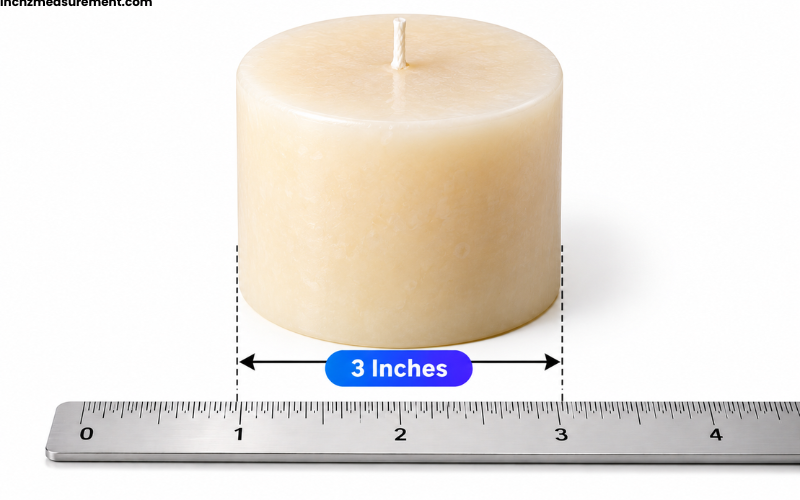
A pillar candle sold with a specified 3-inch diameter provides an exact circular reference. Pillar candles are commonly described using diameter and height, and 3-inch diameters are an established size used for freestanding candle designs.
You may see these candles on dining tables, mantels, decorative trays, wedding displays, and home décor shelves. The relevant measurement here is the diameter across the circular base, not the candle’s height.
Looking straight down at the candle, the distance from one side of the base to the opposite side is three inches. It gives your eyes the same circular span as the regulation hockey puck.
This is a useful visual because the candle has more depth than a sheet of paper. You can hold it, rotate it, and compare its circular base with other objects.
For what objects are 3 inches across, a candle with a documented 3-inch diameter can provide a clear home reference.
6. A 3-Inch Square Sticky Note — 76 Millimeters Per Side
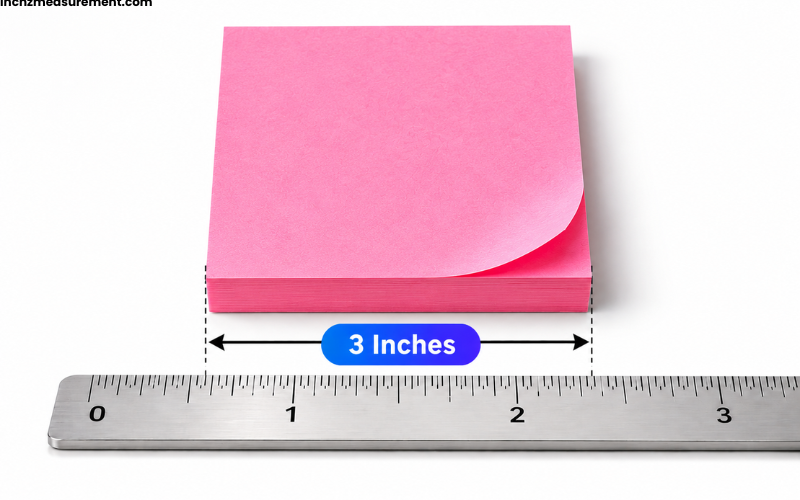
Another exact reference comes from the 3-by-3-inch format of Post-it Notes. 3M also lists versions with the metric equivalent of 76 mm by 76 mm, giving you a direct bridge between imperial and metric measurements.
You can find these square notes in offices, classrooms, home workspaces, planners, and study areas. They are deliberately small enough to fit beside ordinary writing on a page.
The paper feels thin and light, but its 3-inch edge is large enough to see immediately. Place the note flat on a desk and the square becomes a simple visual measuring area.
This is particularly helpful if you think in centimeters rather than inches. One side represents 3 inches, or 7.62 cm, without requiring you to convert the measurement yourself.
That makes a 3-by-3-inch note a convenient example of 3 inches for anyone working between imperial and metric units.
7. A 3-Inch Minimum Parcel Height Compared With a 6-Inch Parcel Length
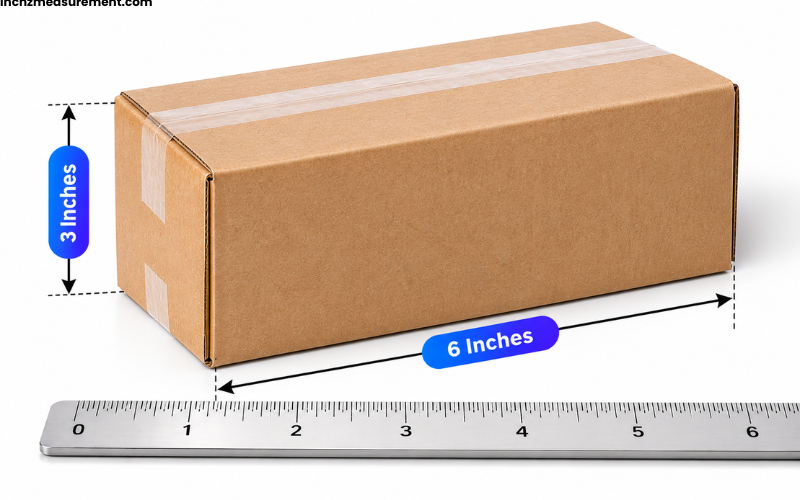
The USPS parcel specification creates another useful visual relationship. Its commercial parcel minimum is 3 inches high and 6 inches long, meaning the 3-inch dimension is exactly half of the minimum 6-inch length.
This kind of parcel is encountered in mailing rooms, shipping departments, post offices, and businesses that send small goods. The dimensions are part of postal preparation rules rather than a guess about a particular box.
When you look at the minimum dimensions together, the three-inch height feels noticeably compact. The six-inch length stretches twice as far, which gives you an immediate proportional comparison.
This reference is useful because you do not need to imagine three inches in isolation. You can mentally divide the six-inch length into two equal sections, with each section measuring three inches.
It is therefore a practical way to understand how long is 3 inches through a real postal dimension.
8. A 3-Inch Hockey Puck Diameter — The Same Width as the Official Game Puck
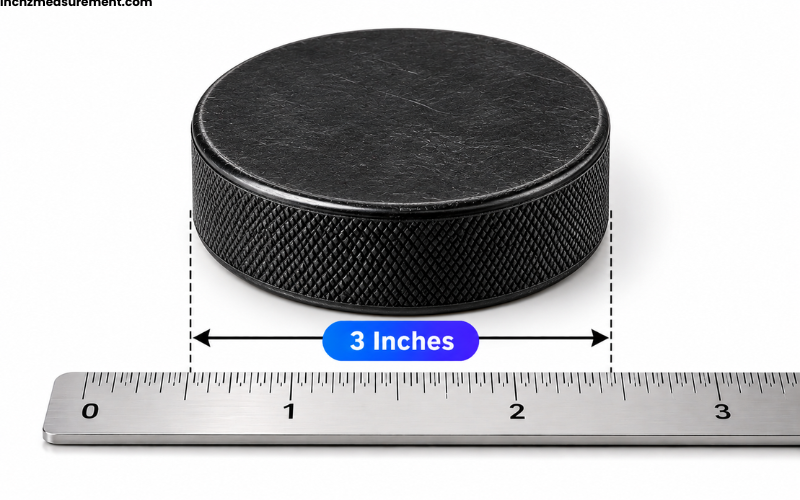
The official hockey puck provides another way to visualize the target measurement from a different perspective: its width across the circular face. IIHF rules specify a puck diameter of 7.6 cm, while the organization’s public material identifies that measurement as 3 inches.
You see this puck sliding across an ice rink during games and sitting on the bench during practices. Players handle it with gloves, sticks, and protective equipment.
Because the puck is only one inch thick, its three-inch diameter is much more noticeable when you look at its flat face. From above, it appears as a compact black circle.
This makes it particularly useful when you need to picture three inches as a width rather than a straight object. The distance is fixed from one outer edge through the center to the opposite edge.
For a dependable sports-based answer to how big is 3 inches, the regulation puck remains one of the best references.
9. A 10d Construction Nail — 3 Inches in Building Work
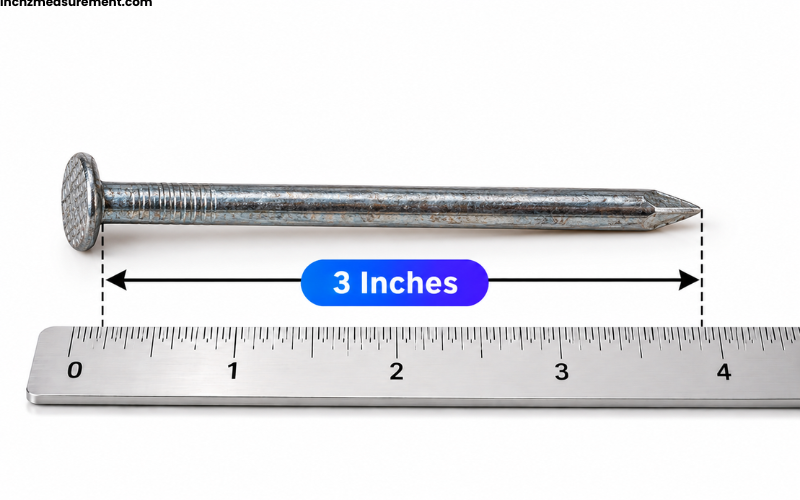
The 10d nail appears again from the construction-standard perspective because its exact length is tied directly to the traditional penny-size designation. Construction guidance states that a 10d nail is 3 inches long, and official construction manuals use the same conversion.
You can encounter 10d nails in framing projects, construction sites, carpentry work, and hardware stores. They are used to join wood members and sheathing in building applications.
Held beside a hand, the nail looks small because its diameter is only a fraction of its length. Lay it flat and its full three-inch span becomes much easier to judge.
The building connection is useful because it shows that three inches is not just an arbitrary measurement. It has a recognized place in construction terminology and fastening specifications.
If you work with lumber or framing materials, a 10d common nail gives you a practical 3 inch example that has a documented standard.
How Big Is 3 Inches?
Indoors, three inches feels like a small but noticeable space. A 3-by-3-inch sticky note gives you a square you can see instantly on a desk, notebook, kitchen counter, or wall. It is much smaller than a typical sheet of paper but large enough to hold several handwritten words.
Outdoors, the measurement becomes easier to underestimate because spaces are much larger. Three inches is only a fraction of the width of a driveway and far less than the length of one normal walking step. That is why a physical reference such as a hockey puck or 3-inch parcel dimension works better than trying to judge the distance against a large outdoor area.
How Tall Is 3 Inches?
Vertically, three inches is a short height. A 3-inch parcel height would rise only a small distance above a desk surface, while a 3-by-3-inch sticky note gives you the same distance from its bottom edge to its top edge.
Now compare that with a house or tree and the scale changes dramatically. A two-story house can rise roughly 20 feet or more, which is 240 inches, so three inches represents only 1/80 of a 20-foot height.
A flagpole makes the difference even more dramatic. A 30-foot flagpole is 360 inches tall, so three inches is only 1/120 of that height. You would need to mentally divide the pole into 120 equal three-inch sections to match the full height.
How Far Is 3 Inches?
Three inches is a very short horizontal distance. At a normal walking pace of 3 miles per hour, you cover roughly 4.4 feet every second, so three inches takes only about 0.0057 seconds of walking time.
Step count is also tiny. If your calibrated walking stride is 30 inches, then three inches equals exactly 0.1 of one stride. In other words, you would move only one-tenth of a normal 30-inch stride to cover three inches.
That is why trying to judge three inches by walking is impractical. Your body movement is simply too large compared with the target distance.
3 Inches Comparison Table
| Comparison | Real-World Reference |
| 3 inches vs 2 inches | A 3-inch hockey puck diameter is 1 inch wider than a 2-inch circle, so the difference is one extra inch across the face. |
| 3 inches vs 4 inches | A 4-inch span is one inch longer than a 3-inch sticky-note edge; placing the two measurements side by side leaves a visible 1-inch difference. |
| 3 inches vs 6 inches | The USPS commercial parcel minimum length is 6 inches, exactly twice the 3-inch minimum height. |
| 3 inches vs 12 inches | A standard 12-inch ruler is four times as long as 3 inches, so the target occupies exactly one-quarter of the ruler. |
| 3 inches vs 7.62 cm | These are the same physical distance, expressed in different measurement systems. |
How to Measure 3 Inches Without a Tape Measure
Method 1 — Using Your Steps
Your normal walking stride is far too large to estimate three inches directly, so first calibrate it. Walk ten comfortable steps across a flat surface and measure that total distance later when you have a known reference. If your ten steps cover 25 feet, your average stride is 2.5 feet, or 30 inches.
Once you know your stride is 30 inches, three inches is exactly one-tenth of that stride. Do not actually take a full step; instead, use the relationship to understand the proportion. Mark the beginning of one stride and visually divide the distance into ten equal parts. One part represents three inches.
For a better result, repeat the calibration several times because stride length changes with walking speed. This method is mainly useful for building a mental scale, not for precision work.
Method 2 — Using Floor Tiles
Floor tiles can provide a more practical visual reference if you know their exact size. A common square tile may be 12 by 12 inches, while larger tiles can be 24 by 24 inches, so first check the printed packaging, installation specification, or a known dimension.
With a 12-inch tile, three inches equals exactly one-quarter of the tile’s side. Place an imaginary line across the tile and divide the 12-inch edge into four equal sections. Each section represents three inches.
With a 24-inch tile, three inches equals one-eighth of the side. Count carefully rather than guessing because grout joints add space between installed tiles. This method works best with a single tile whose actual manufactured dimension is known.
Method 3 — Using Your Body
Your body can help you build a quick mental reference, but you should calibrate it first. For example, measure the width of your palm or the length of one finger when you have access to a ruler, then remember the relationship.
If your palm width measures 4 inches, three inches represents three-quarters of that width. If a finger segment measures 1.5 inches, two such segments equal three inches exactly.
Another option is to use your arm span as a large-scale calibration. A person with a 72-inch arm span can divide that distance mentally into 24 equal three-inch sections. This is not suitable for precise construction work, but it gives you a repeatable way to recognize the proportion of three inches when no measuring tool is available.
Related Post: 10 Everyday Objects That Are About 1 Inch
FAQ
Q1: How long is 3 inches in meters?
Three inches equals exactly 0.0762 meters. The same measurement is 7.62 centimeters or 76.2 millimeters.
Q2: How many steps is 3 inches?
Three inches is only 0.1 of a 30-inch stride. At a 30-inch walking stride, you would need one-tenth of a stride to cover three inches, so taking a normal walking step is far too large for this measurement.
Q3: How tall is 3 inches compared to a house?
Three inches is extremely small compared with a house. A 20-foot house height equals 240 inches, so three inches represents exactly 1/80 of 20 feet.
Q4: Is 3 inches bigger than a school bus?
No. A school bus is measured in feet, not inches, and is many times longer than 3 inches. Even a 30-foot bus is 360 inches long, making it exactly 120 times longer than three inches.
Q5: How long does it take to walk 3 inches?
At a walking speed of 3 miles per hour, three inches takes roughly 0.0057 seconds to cover. A normal walking stride is much longer than three inches, so the distance represents only a small fraction of one step.
Conclusion
The clearest exact references are the 3-inch regulation hockey puck, the 3-by-3-inch Post-it Note, and the 3-inch 10d common nail. Each gives you a physical dimension you can picture instead of relying on a decimal conversion alone.
Keep this page bookmarked whenever you need a quick answer to how long is 3 inches or how big is 3 inches. For everyday visualization, use the hockey puck or sticky note; for construction work, use the specified 10d nail. For anything where an exact fit matters, verify the dimension with a ruler or caliper before cutting, drilling, or installing.