
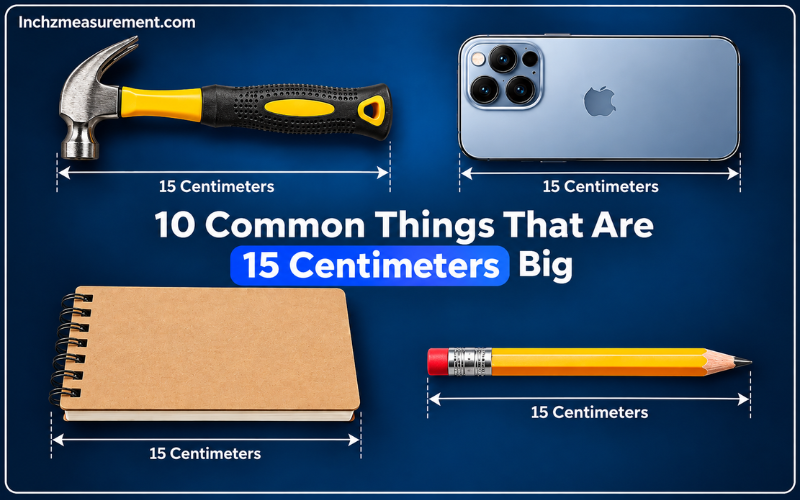
15 centimetres is equal to 5.91 inches, or 150 millimetres. It is a fairly short length that fits comfortably in one hand, making it easy to visualise with familiar objects. A 15 cm ruler gives you an exact reference, while items such as a smartphone, craft stick, postcard, or small kitchen knife can help you picture the size in everyday life. Because many household objects are made in standard sizes, they can provide useful comparisons when you do not have a ruler nearby.
If you are asking how big 15 centimetres is for a craft project, shopping decision, school task, or simple measurement, comparing it with objects you already recognise can make the length much easier to knowing.
[mzmeasure value=”15″ unit=”centimeters” example=”15 cm ruler”]
How Long Is 15 Centimeters?
15 centimetres is a metric measurement of length equal to 150 millimetres and approximately 5.91 inches. In feet, it is about 0.49 feet, so it is just slightly shorter than half a foot.
For everyday purposes, the easiest way to picture 15 cm is to think of a short ruler. A standard 15 cm ruler reaches exactly from 0 to 15 cm, making it an especially useful reference. The length is also very close to 6 inches, since 6 inches equals 15.24 cm. That means an object measuring exactly 15 cm is only 0.24 cm, or 2.4 mm, shorter than six inches.
You may encounter a 15 cm measurement on stationery, craft materials, small tools, packaging, kitchen equipment, and electronic devices. It is long enough to span much of an adult hand but short enough to fit easily inside a pocket or pencil case.
[mztable value=”15″ unit=”Centimeters”]
How Big Is 15 Centimeters?
The easiest way to imagine 15 centimetres is to picture something a little shorter than a 6-inch object. It is roughly the length of a small ruler and can fit across the palm of many adults. However, hand sizes vary, so your own hand should only be used as a rough reference.
A modern smartphone can also provide a useful visual comparison. Some compact phones measure close to 15 cm from top to bottom, although phone dimensions vary considerably between models. A postcard with a long side of around 15 cm is another useful reference.
If you have standard A4 paper, its shorter side is 21 cm, so 15 cm is about six centimetres shorter. This gives you a simple way to estimate the length using a familiar sheet of paper. The important point is that 15 cm is not a tiny measurement. It is about the length of a small ruler, a little under 6 inches, and large enough to be easily visible in everyday objects.
10 Common Things That Are 15 Centimeters Long
Several ordinary objects are close to 15 centimetres in length. Some are manufactured to exactly 15 cm, while others vary slightly depending on the product or design. The table below gives a quick reference before looking at each example in more detail.
| Everyday Item | Actual Size |
| 15 cm Ruler | 15 centimetres |
| Wooden Craft Stick | 15 centimetres |
| Small Kitchen Knife Blade | 15 centimetres |
| A6 Postcard | 15 centimetres |
| Compact Smartphone | 15 centimetres |
| Six-Inch Sandwich | 15 centimetres |
| Short Pencil | 15 centimetres |
| Small Notebook | 15 centimetres |
| Standard Playing Card Stack | 15 centimetres |
| Small Hand Tool | 15 centimetres |
1. 15 cm Ruler
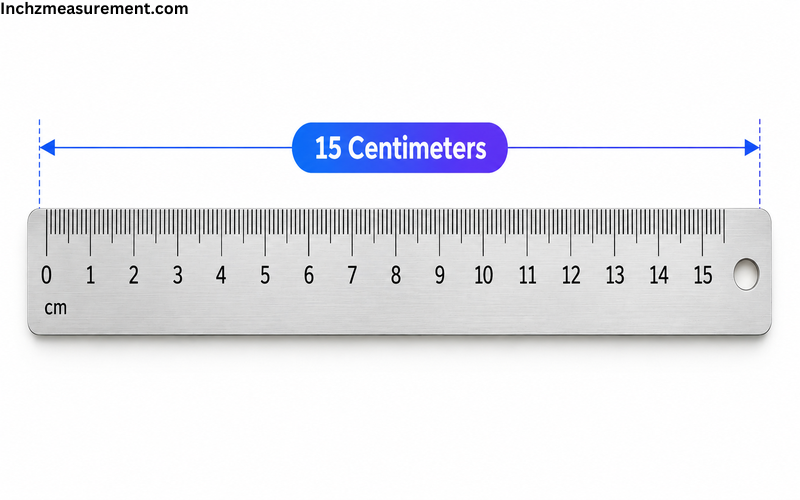
A 15 cm ruler is perhaps the simplest object to use when you want to understand this measurement because it is designed to be exactly 15 centimetres long. Many small plastic or wooden rulers are made to this length, especially those intended for pencil cases, school supplies, and compact stationery sets.
The ruler provides an exact visual reference from one end to the other. If you place it beside another object, you can immediately see whether that object is shorter, longer, or approximately the same length.
A 15 cm ruler is also useful because it has clearly marked centimetre and millimetre divisions. You can use it to check small craft projects, measure stationery, or estimate the dimensions of household objects. If you are trying to remember what 15 cm looks like, simply picturing a short school ruler is one of the most reliable methods.
2. Wooden Craft Stick
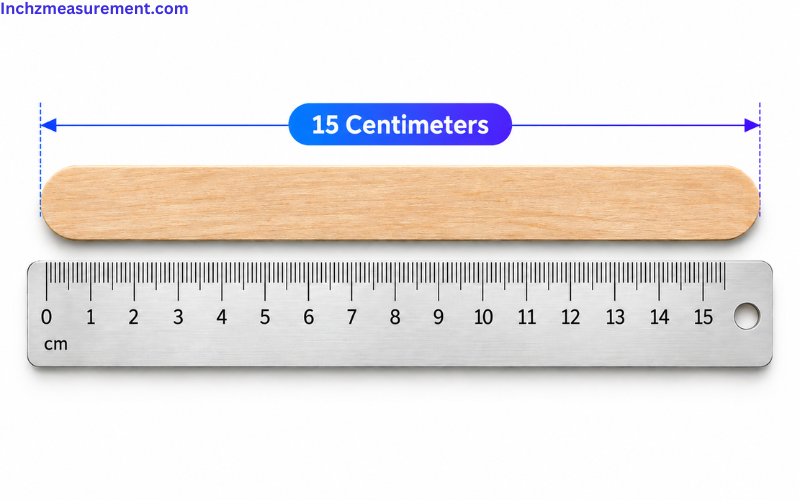
Some wooden craft sticks are manufactured at around 15 centimetres long, making them a convenient comparison for this measurement. These longer craft sticks are commonly used for model making, school projects, decorative work, and DIY activities.
Unlike a standard small lolly stick, which is usually considerably shorter, a 15 cm craft stick gives you a much closer reference for the target length. The stick is narrow, straight, and easy to hold, so its overall length is simple to visualise.
If you have one at home, place it next to a 15 cm ruler to check its actual size. Some products may be slightly longer or shorter, so it should be treated as an approximate comparison unless the packaging specifies a 15 cm length. For crafts, however, a stick of this size can give you a useful physical representation of how long 15 centimetres is.
3. Small Kitchen Knife Blade
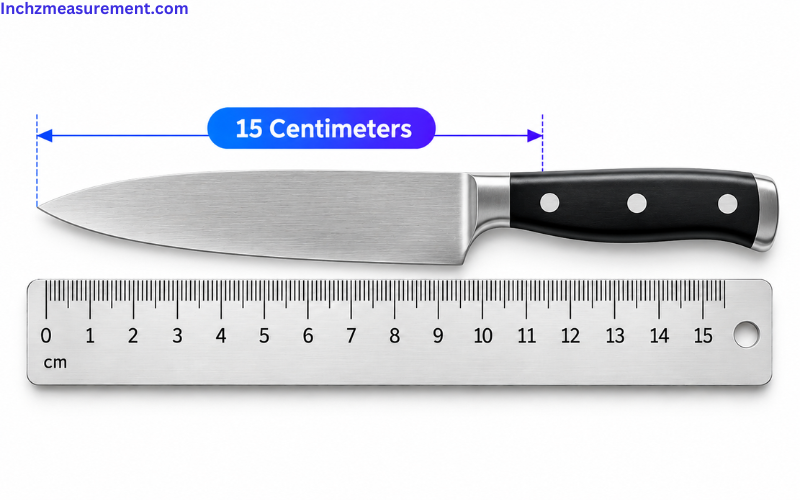
A small kitchen knife can have a blade measuring around 15 centimetres, although the exact size depends on the type of knife. Compact utility knives, small preparation knives, and some paring-style kitchen knives can have blades close to this length.
The blade itself is a useful comparison because it provides a straight measurement that can be compared directly with a ruler. If the blade is about 15 cm from the tip to the point where it meets the handle, it gives you a good visual idea of the target length.
Keep in mind that the overall knife will normally be longer because the handle adds extra length. When using this example for measurement, focus only on the blade rather than the complete knife. A kitchen knife is therefore best treated as an approximate comparison unless its specifications state an exact 15 cm blade length.
4. A6 Postcard
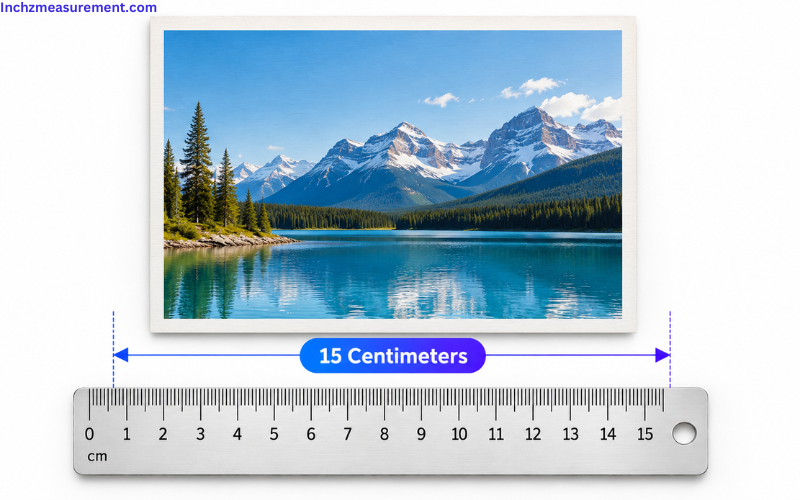
An A6 postcard measures 14.8 cm along its longer side, which is extremely close to 15 centimetres. It is only 2 millimetres shorter, so an A6 postcard is a particularly useful everyday object for visualising this measurement.
A6 is a common paper size measuring 10.5 cm by 14.8 cm. You may find this size in postcards, invitations, small prints, cards, and stationery. Because the dimensions are standardised, the long edge gives you a consistent reference.
If you place an A6 postcard beside a 15 cm ruler, the difference is very small. You would need only another 2 mm to reach exactly 15 cm. This makes the postcard more useful than many random household objects when you need a close visual estimate. It also gives you an easy paper-based comparison without needing specialist measuring equipment.
5. Compact Smartphone
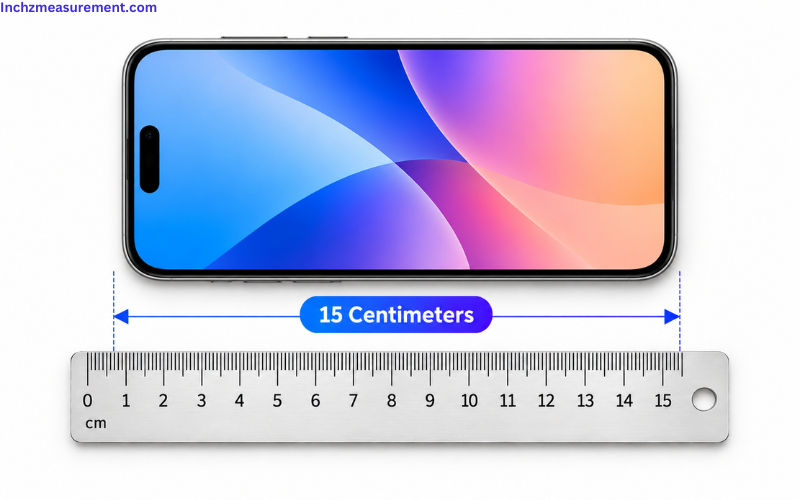
Some compact smartphones have a height close to 15 centimetres. Phone dimensions vary widely, so this should be considered an approximate comparison rather than a fixed standard.
The advantage of using a smartphone as a reference is that most people are already familiar with its physical size. If your phone measures around 15 cm from its top edge to its bottom edge, you can use it as a convenient reference when estimating the measurement elsewhere.
A phone can also help you understand the scale of 15 centimetres because it is a familiar object that fits comfortably in one hand. Larger smartphones may be noticeably longer than 15 cm, while smaller models may be shorter. Check the manufacturer’s dimensions if you need accuracy for a case, holder, pocket, or other fitting task. For simple visualisation, however, a compact phone can provide a helpful approximation.
6. Six-Inch Sandwich
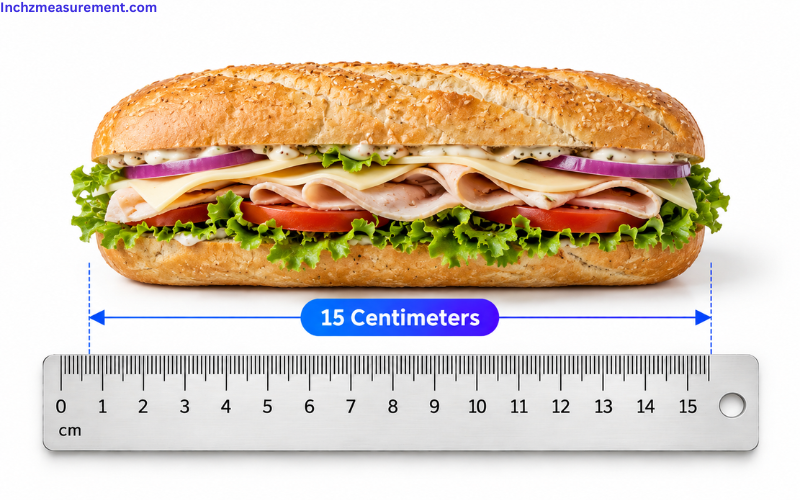
A six-inch sandwich is very close to 15 centimetres long. Six inches converts to 15.24 cm, meaning it is only 2.4 millimetres longer than 15 cm. That small difference makes a six-inch sandwich an easy real-world comparison.
The length is particularly useful because many people recognise the standard six-inch size from sandwich shops and takeaway menus. If you picture a sandwich measuring six inches from end to end, you are essentially picturing a length of 15 centimetres.
This comparison also helps connect metric and imperial measurements. If someone describes an object as 15 cm and you are more familiar with inches, thinking of a six-inch sandwich can make the size easier to grasp. It is not exactly 15 cm, but the difference is small enough for ordinary visual comparison.
7. Short Pencil
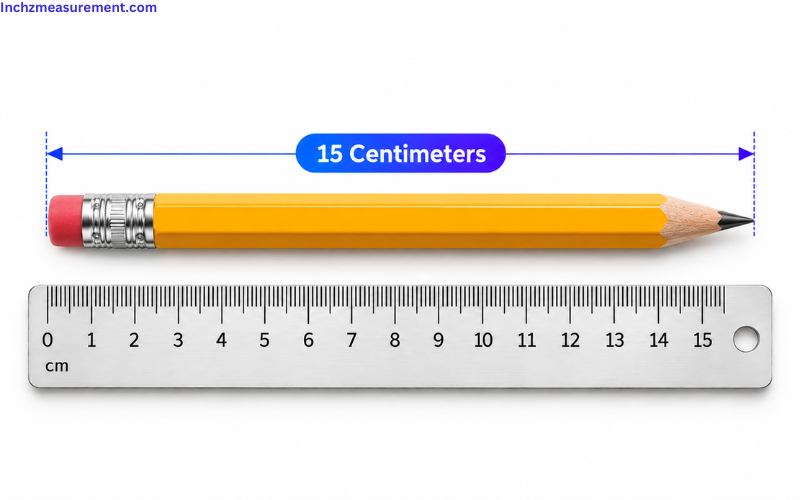
A short pencil can measure around 15 centimetres, particularly after it has been sharpened several times. New standard pencils are often longer than this, but repeated sharpening gradually reduces their length.
A pencil measuring 15 cm is convenient because it is a straight, narrow object that can be placed alongside a ruler for comparison. You can also use its familiar proportions to estimate the measurement when you are away from your measuring tools.
Not every pencil will be 15 cm long. Some writing pencils are manufactured in different lengths, and a heavily used pencil can become considerably shorter. For that reason, a pencil should be treated as an approximate reference unless you have measured it. If you happen to own a short pencil that is close to 15 cm, it can nevertheless be an excellent pocket-sized reminder of the measurement.
8. Small Notebook
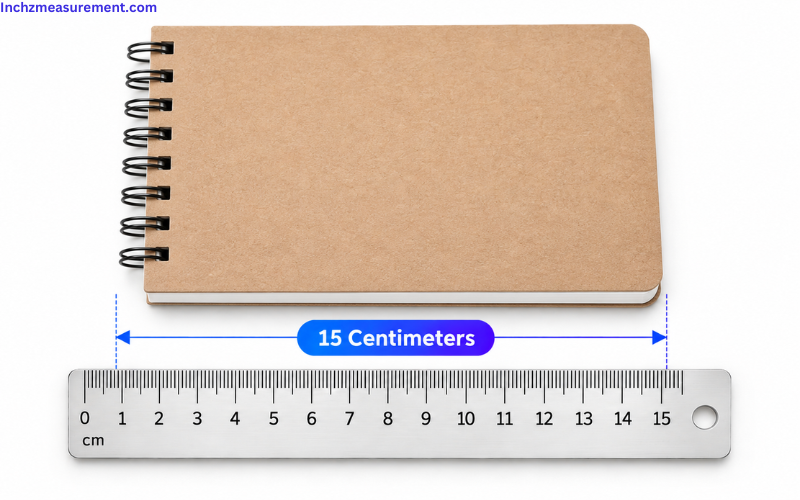
Some compact notebooks have a long side close to 15 centimetres. Their exact dimensions depend on the manufacturer and paper format, so the notebook is best used as a visual comparison rather than an exact measuring standard.
A small notebook can make 15 cm easier to picture because it has a familiar rectangular shape. Looking at its height or width gives you a sense of how much space the measurement covers. Some pocket notebooks are close to this size, while others may be significantly smaller or larger.
If you need an accurate measurement, check the notebook’s listed dimensions or measure it with a ruler. For a quick estimate, however, a notebook that is approximately 15 cm on one side provides a useful reference. It is especially handy when comparing the size of stationery, small bags, cases, or other everyday items.
9. Standard Playing Card Stack
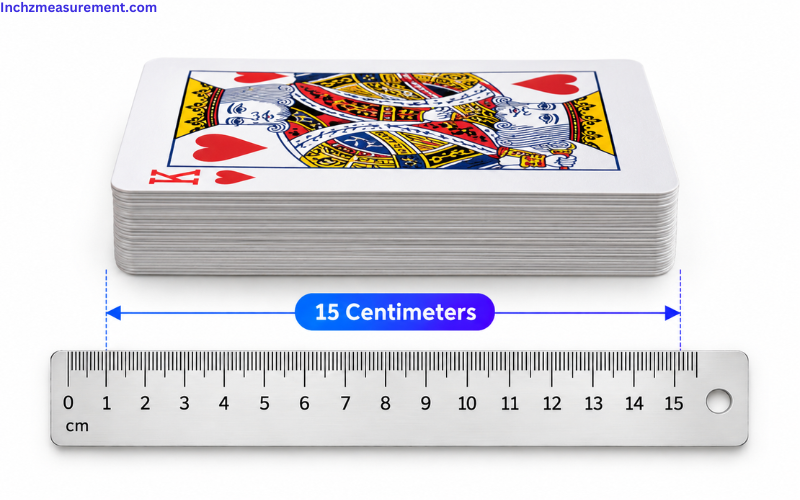
A single playing card is far shorter than 15 centimetres, but a stack of cards can approach this length when arranged end-to-end. This is therefore a comparison that requires several cards rather than one individual card.
For example, placing playing cards in a straight line can help you build up a visual estimate of 15 cm. Because standard playing cards are manufactured to fairly consistent dimensions, they can be useful for rough comparisons. However, the exact number needed depends on which edge you use and how accurately the cards are positioned.
This example is most useful when you have cards available but no ruler. Arrange them carefully in a straight line and compare the total distance with your target. It is less convenient than using a 15 cm ruler, but it demonstrates how familiar objects can be combined to estimate a length.
10. Small Hand Tool
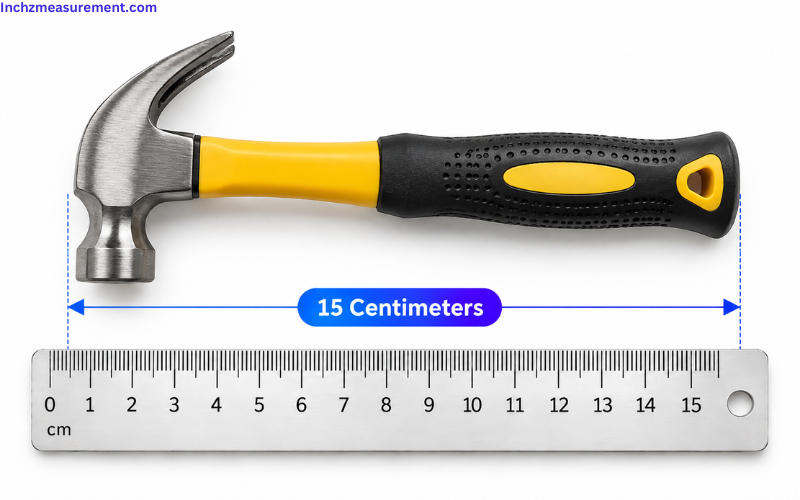
Certain compact hand tools, such as short screwdrivers, small files, and compact measuring or workshop tools, can be around 15 centimetres long. Their dimensions vary considerably, so this category should be treated as an approximate reference.
A straight tool is particularly useful for visualising 15 cm because you can compare its complete length with the target measurement. A tool that is slightly shorter or longer can still give you a reasonable idea of the scale.
If you are using a hand tool as a measurement reference, do not assume its advertised or perceived size is exactly 15 cm. Handles, tips, and working ends can also make measurements less obvious. For a practical estimate, simply compare the tool with a known 15 cm object first. This gives you a better sense of how close it really is.
Related Post: 11 Everyday Objects That Are About 14 Centimeters Big
Measurement Without a Ruler
You can estimate 15 centimetres without a ruler by using familiar objects, paper, or parts of your hand. These methods will not provide the same accuracy as a proper measuring tool, but they can be useful for quick estimates.
One option is to use an A6 postcard. Its longer side is 14.8 cm, which is just 2 mm shorter than 15 cm. If you have one available, it provides a very close paper reference.
Your hand can also help. The width across your palm or the distance between parts of your fingers may be somewhere around this range, but hand sizes differ from person to person. Treat this only as a rough estimate.
Another useful reference is six inches. Since six inches equals 15.24 cm, you can visualise 15 cm as being almost exactly the length of a six-inch object. A 6-inch ruler, for example, is only slightly longer than 15 cm.
FAQs
Is 15 cm the same as 6 inches?
Not exactly. 15 centimetres is approximately 5.91 inches, while 6 inches equals 15.24 centimetres. The difference is only 0.24 cm, or 2.4 mm, so the two measurements are extremely close for everyday visual comparisons.
How many inches is 15 centimetres?
15 centimetres is approximately 5.91 inches. To convert centimetres to inches, divide the centimetre measurement by 2.54. Therefore, 15 ÷ 2.54 gives approximately 5.9055 inches, which is normally rounded to 5.91 inches.
How many millimetres are in 15 centimetres?
There are 150 millimetres in 15 centimetres. One centimetre contains 10 millimetres, so multiplying 15 by 10 gives 150 mm. This conversion is exact and is useful for small DIY, craft, engineering, and stationery measurements.
What does 15 cm look like?
15 cm looks roughly like a small ruler or the length of a compact smartphone. It is also very close to the long side of an A6 postcard, which measures 14.8 cm. These familiar objects can make the measurement easier to picture than a numerical value alone.
Is 15 cm long or short?
15 cm is generally a short everyday length. It is about 5.91 inches, so it is slightly shorter than half a foot. It can fit easily into one hand and is commonly seen in small stationery, tools, craft materials, packaging, and compact electronic devices.
Can I measure 15 cm with my hand?
You can make a rough estimate using your hand, but it will not be exact because hand sizes differ. The width of your palm or a combination of finger lengths may get you close. For accurate work, use a ruler or another object with a known 15 cm dimension.
What common object is closest to 15 cm?
An A6 postcard is particularly close because its longer side measures 14.8 cm, only 2 mm short of 15 cm. A six-inch object is also very close because six inches equals 15.24 cm. A 15 cm ruler, where available, provides an exact reference.
How can I remember how big 15 cm is?
A simple way to remember 15 cm is to think of it as almost 6 inches. You can also picture a 15 cm ruler, an A6 postcard’s long edge, or a compact smartphone. These references give you a practical sense of the size without needing to remember the number alone.
Conclusion
15 centimetres is a relatively short length that is easy to picture once you connect it with familiar objects. It equals 150 mm and about 5.91 inches, making it just a little shorter than 6 inches. A 15 cm ruler provides the most direct exact reference, while an A6 postcard is only 2 mm shorter.
A six-inch sandwich is also remarkably close at 15.24 cm. For rough estimates, a compact smartphone, short pencil, or small notebook can help you visualise the scale, although their actual dimensions vary. The easiest memory trick is to think of 15 cm as almost exactly six inches and slightly shorter than half a foot.