
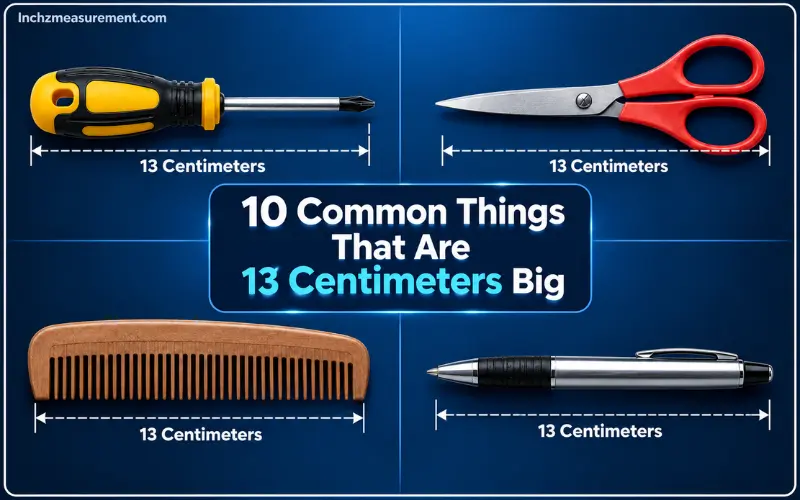
13 centimetres is equal to 5.12 inches or 130 millimetres. It is a little longer than 5 inches, making it a fairly short everyday length. To picture it, imagine the long side of a standard 3 × 5 inch index card, which is about 12.7 centimetres. That is almost exactly 13 centimetres.
A 13 cm length can also be compared with small stationery items, pocket tools, cards, combs and kitchen utensils. These comparisons are useful when you do not have a ruler nearby and need a quick idea of how long something is. The exact size of everyday objects varies, so the examples below should be treated as practical visual references rather than precise measuring instruments.
[mzmeasure value=”13″ unit=”centimeters” example=”3 × 5 inch index card”]
How Long Is 13 Centimeters?
13 centimetres is a metric measurement equal to 130 millimetres and approximately 5.12 inches. In everyday use, that means 13 cm is just slightly longer than a standard 5-inch length.
The difference from 5 inches is small. Five inches equals 12.7 cm, so 13 cm is only about 3 millimetres longer. This makes a 5-inch ruler or the long side of a 3 × 5 inch index card particularly useful for visualising the measurement.
A length of 13 cm is small enough to fit comfortably in one hand but long enough to describe many compact household objects. You might encounter a similar length in stationery, small personal items, kitchen tools and pocket accessories.
If you need to measure something precisely, use a ruler or tape measure. Everyday comparisons are best used for estimating rather than confirming an exact measurement.
Related Post: 10 Everyday Objects That Are About 11 Centimeters Big
[mztable value=”13″ unit=”Centimeters”]
How Big Is 13 Centimeters?
A length of 13 centimetres can be easier to picture when you compare it with something familiar. The long side of a 3 × 5 inch index card is about 12.7 cm, so it is almost the same length. You would need to add only around 3 mm to reach 13 cm.
Another useful reference is a small pocket comb, many of which measure around 12–14 cm from end to end. Some teaspoons and compact sewing scissors also fall close to this range, although their dimensions differ between designs.
You can also use your hand as a rough guide. For many adults, the width of four fingers held together may be somewhere around 7–9 cm, so 13 cm will usually extend noticeably beyond that width. Hand sizes vary considerably, however, so this method should only give you a rough impression.
10 Common Things That Are 13 Centimeters Long
The objects below are familiar items whose length or one main dimension is close to 13 centimetres. Some are very close to the target, while others vary by brand or design. The table gives the target measurement only; the descriptions explain how closely each item compares.
| Everyday Item | Actual Size |
|---|---|
| 3 × 5 inch index card | 13 centimetres |
| 5-inch ruler | 13 centimetres |
| Passport booklet | 13 centimetres |
| Pocket comb | 13 centimetres |
| Teaspoon | 13 centimetres |
| Small sewing scissors | 13 centimetres |
| Small paintbrush | 13 centimetres |
| Pencil case zipper pouch | 13 centimetres |
| Nail file | 13 centimetres |
| Small kitchen spatula | 13 centimetres |
1. 3 × 5 Inch Index Card
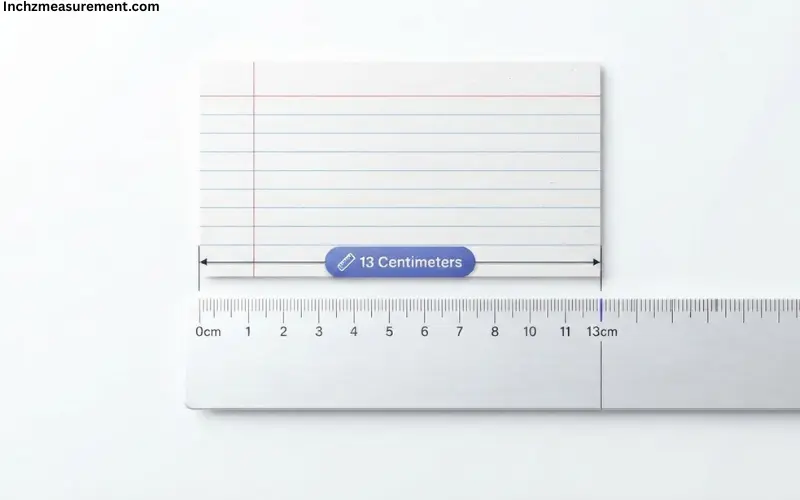
A standard 3 × 5 inch index card is one of the closest everyday comparisons for 13 centimetres. Its longer side measures 5 inches, which converts to 12.7 cm. That is only 0.3 cm, or 3 mm, shorter than 13 cm.
This makes an index card particularly useful if you need to visualise the measurement without a ruler. Place the card on a flat surface and look at its longer edge. A 13 cm line would extend just a few millimetres beyond the card.
Index cards are commonly used for study notes, revision cards, recipes and short reminders. Because their dimensions are standardised in many places, they provide a more dependable comparison than objects whose sizes vary widely.
If you are trying to picture 5 inches in everyday life, the long edge of this card is also a useful reference because 5 inches and 13 cm are extremely close.
2. 5-Inch Ruler
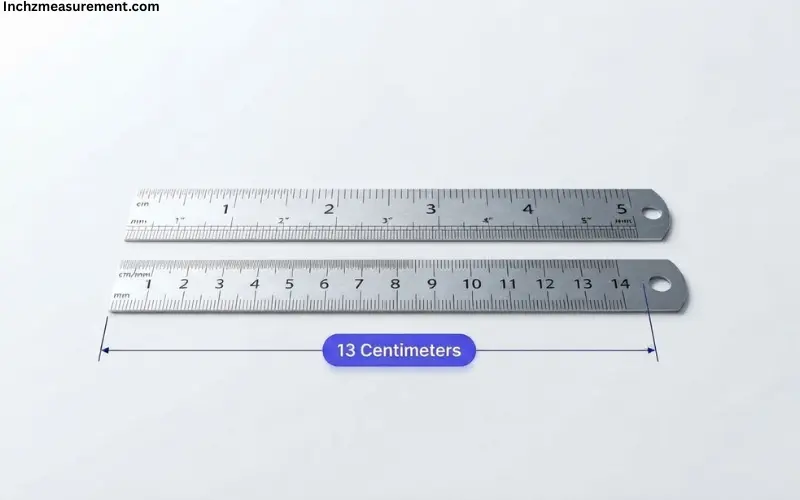
A small ruler marked up to 5 inches provides another simple comparison. Five inches equals 12.7 cm, so a 13 cm length is only about 3 mm longer.
Small rulers are often included in stationery sets, pencil cases and geometry kits. They are also useful for comparing short objects because their markings make small differences easier to see.
If you have a ruler that is exactly 5 inches long, place one end at the beginning of the object or line you want to compare. A 13 cm length should extend slightly past the ruler’s 5-inch end. The difference is small enough that you may not notice it easily without millimetre markings.
This makes the 5-inch ruler a practical visual aid, but it should not be described as exactly 13 cm. The actual conversion is 12.7 cm.
3. Passport Booklet
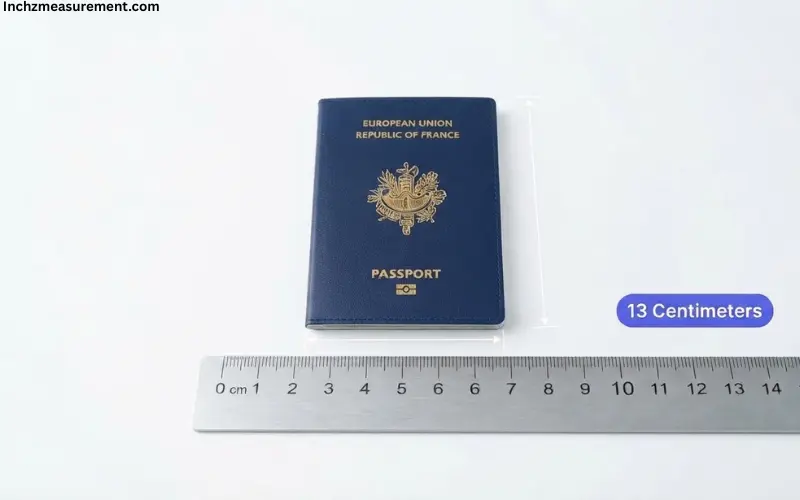
A passport booklet is another useful comparison because its height is commonly close to 12.5 cm, depending on the passport standard and edition. That puts it only about half a centimetre below 13 cm.
When closed, the passport’s shorter side can give you a quick visual idea of this length. It is not an exact 13 cm reference, but the difference is small enough to make it useful for a rough estimate.
Passports are also familiar objects, so most people can picture their size even when they do not have one immediately available. If you imagine a 13 cm line running along the shorter edge of a typical passport, the line would be slightly longer.
Measurements can vary between passport formats, so use this comparison only for estimation rather than precise measurement.
4. Pocket Comb
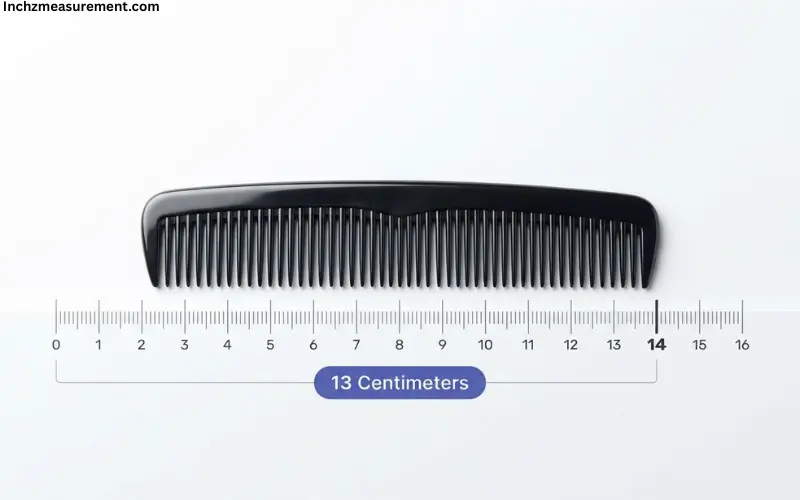
Many compact pocket combs measure roughly 12–14 cm from one end to the other. A comb around 13 cm long is therefore a close match for the target measurement.
Pocket combs are designed to be small enough to carry in a bag, pocket or toiletry case. Their compact size makes them useful for visualising measurements in the 10–15 cm range.
To use one as a reference, place the comb on a flat surface and compare its full length with the distance you are trying to estimate. If the comb is close to 13 cm, the two lengths should look almost identical.
Not every pocket comb has the same dimensions. Some are shorter, while folding combs can have different measurements when opened or closed. Check the actual size if accuracy matters.
5. Teaspoon
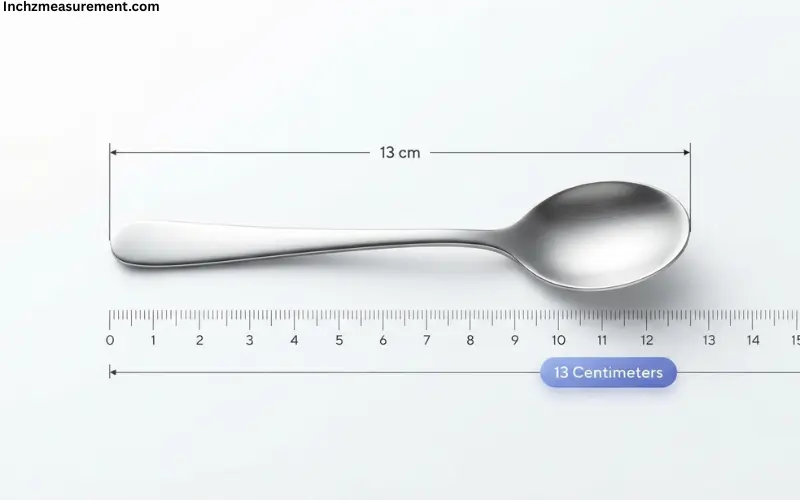
A typical teaspoon is often around 13–15 cm long, measured from the end of the handle to the tip of the bowl. Some teaspoons are shorter or longer, so this is an approximate comparison rather than an exact one.
A teaspoon is useful because it is a familiar kitchen item and its overall length is easy to see. If you have a compact teaspoon measuring close to 13 cm, it can provide a quick reference for this measurement.
Lay the spoon straight on a table and compare it with the distance you want to estimate. A 13 cm line would be roughly the same length as a shorter teaspoon.
Do not confuse the spoon’s overall length with the size of its bowl. The bowl itself is much shorter than 13 cm. The comparison refers to the complete spoon from end to end.
6. Small Sewing Scissors
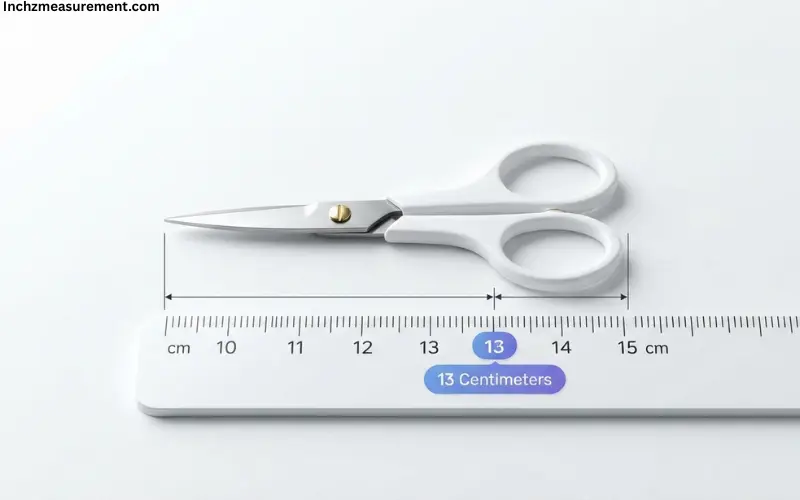
Small sewing or embroidery scissors can measure around 10–13 cm overall, with compact models often coming close to 13 cm. Their size makes them a handy comparison for a short measurement.
Unlike large household scissors, these smaller scissors are designed for detailed cutting work. They are commonly used for sewing, embroidery, crafts and trimming loose threads.
To visualise 13 cm, look at the full length of the closed scissors rather than just the blades. If the scissors are approximately 13 cm long, they will give you a close physical representation of the target.
There is considerable variation between scissors. Some compact models are only about 10 cm long, while others may be longer than 13 cm. For that reason, treat this as an approximate example unless the product’s stated dimensions confirm the exact length.
7. Small Paintbrush
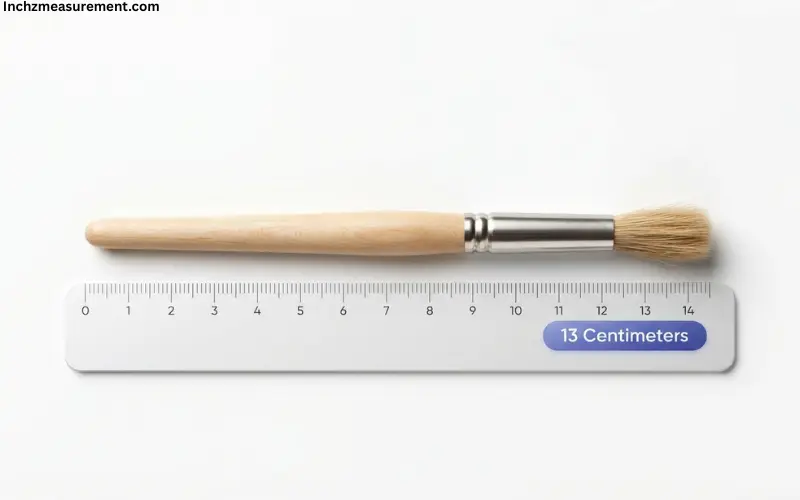
A small artist’s or craft paintbrush can be close to 13 cm long. Many compact brushes fall somewhere in the 12–15 cm range, depending on the handle and intended use.
The complete brush length is the useful measurement here, from the end of the handle to the tip of the bristles. A brush measuring about 13 cm gives you a compact object that can be held easily in one hand.
Paintbrushes are particularly useful as visual references because their narrow shape makes their overall length easy to compare with a straight line. You can place one beside an object or mark a starting point and see how far the brush reaches.
Because brush manufacturers use different handle lengths, this is not an exact universal comparison. Check the brush dimensions when you need a reliable measurement.
8. Pencil Case Zipper Pouch
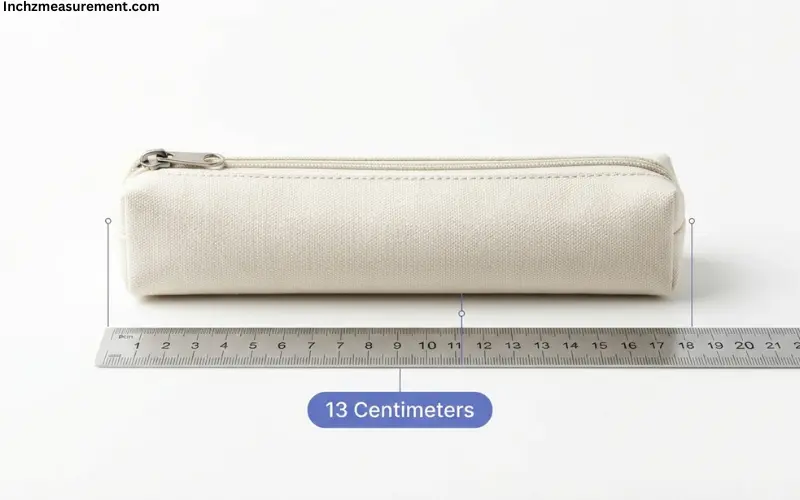
Small pencil cases and zipper pouches are available in many sizes, with compact models often measuring around 13 cm along their shorter or longer side. A pouch close to this size can help create a practical mental image of the measurement.
Unlike a ruler, a pouch does not provide markings, so it should only be used as a rough comparison. Place the pouch flat and look at its longest straight edge. If it is approximately 13 cm, that edge gives you a useful reference.
Small zipper pouches are commonly used for pencils, pens, makeup items, cables and other compact belongings. Their dimensions vary greatly, so there is no single standard size.
For a more reliable comparison, check the manufacturer’s listed dimensions. If the pouch is described as 13 cm long, it can serve as a direct real-world example of the measurement.
9. Nail File
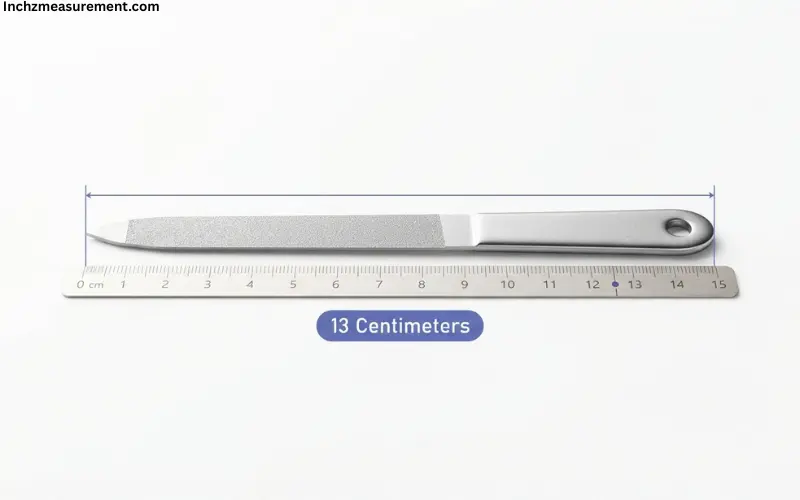
A compact nail file can measure around 13 cm from end to end. Many personal-care nail files are available in different lengths, but a shorter file close to this size provides a convenient comparison.
Its straight, narrow shape makes the length easy to visualise. Place the nail file on a flat surface and compare it with the distance you are trying to estimate. If the file is 13 cm long, its full edge represents the target measurement closely.
Nail files are common household and travel items, which makes them useful for mental comparisons. A file can also fit easily beside a notebook, phone or other object when making rough size comparisons.
Keep in mind that nail files come in several sizes. Some are much shorter, while professional files may be longer. The comparison works best when the particular file has a stated length close to 13 cm.
10. Small Kitchen Spatula
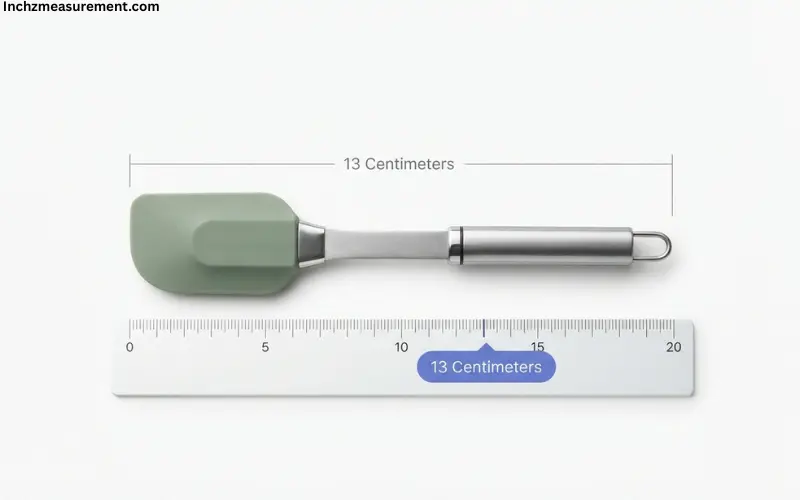
A compact kitchen spatula can be close to 13 cm long, particularly small silicone spatulas designed for jars, baking and detailed food preparation. Larger cooking spatulas are usually much longer.
For this comparison, consider the full length from the end of the handle to the end of the flexible head. A compact model around 13 cm can give you a good physical sense of the target length.
Small spatulas are useful in kitchens because they can reach into jars and scrape mixtures from bowls. Their compact design also makes them easy to hold and compare with other short objects.
This is an approximate example because kitchen utensils are produced in many shapes and sizes. If your spatula is noticeably longer than a typical compact model, it may not be a close comparison. Product dimensions are the best way to check.
Measurement Without a Ruler
You can estimate 13 centimetres without a ruler by using familiar objects, but remember that these methods are only approximate.
A 3 × 5 inch index card is probably the simplest reference. Its long side is 12.7 cm, which is just 3 mm shorter than 13 cm. If you can picture the card, you can picture 13 cm as being just slightly longer than its long edge.
A 5-inch ruler works in a similar way. Five inches is 12.7 cm, so the target extends only a few millimetres beyond the 5-inch mark.
Your fingers or hand can also provide a rough estimate. However, hand proportions differ from person to person. Rather than assuming that a particular finger width always equals a fixed measurement, use your own hand as a personal reference after comparing it with a known measurement.
For better accuracy, combine a familiar object with a marked ruler whenever one becomes available.
FAQs
Is 13 cm the same as 5 inches?
No. 13 cm is approximately 5.12 inches, while 5 inches is exactly 12.7 cm. The difference is only 3 mm, so the two lengths look almost identical in everyday situations. This is why a 5-inch ruler or the long side of a 3 × 5 inch index card is a useful comparison for 13 cm.
How many millimetres are in 13 cm?
There are 130 millimetres in 13 centimetres. One centimetre contains 10 millimetres, so you can convert 13 cm to millimetres by multiplying 13 by 10. The result is 130 mm. This is the exact metric conversion.
Is 13 cm a small measurement?
Yes, 13 cm is a relatively short everyday measurement. It is slightly longer than 5 inches and can fit comfortably across many small household objects. A compact comb, small utensil or index card can help you picture the size. It is much shorter than objects such as a standard ruler or sheet of paper.
What does 13 cm look like?
13 cm looks slightly longer than a 5-inch length. A standard 3 × 5 inch index card has a long side of about 12.7 cm, so adding roughly 3 mm gives you 13 cm. This is one of the easiest ways to visualise the measurement without needing to imagine a metric scale.
Can I measure 13 cm with my hand?
You can make a rough estimate with your hand, but it will not be precise because everyone’s hands and fingers are different sizes. A better approach is to compare your hand with a known object first. Once you know roughly how much of your hand represents 13 cm, it can become a useful personal measuring reference.
What common object is closest to 13 cm?
A 3 × 5 inch index card is one of the closest common references. Its long side is 12.7 cm, only 3 mm shorter than 13 cm. A 5-inch ruler has the same 12.7 cm length. These are closer than many household objects whose dimensions vary considerably.
How can I estimate 13 cm without a ruler?
Use the long side of a 3 × 5 inch index card or a 5-inch ruler as a reference. Both are 12.7 cm, which is very close to 13 cm. You can think of 13 cm as that length plus about 3 mm. Body measurements can also help, but they are less reliable.
Is 13 cm long enough to fit in your hand?
For most adults, a 13 cm object is easy to hold in one hand. It is about the length of a compact comb, small tool or short kitchen utensil. The object may feel different depending on its width and shape, but its overall length is still relatively small compared with everyday items such as books or rulers.
Conclusion
13 centimetres is a little more than 5 inches, measuring exactly 130 mm or about 5.12 inches. The easiest reference is a 3 × 5 inch index card because its 12.7 cm long side is only 3 mm shorter. A small ruler, compact comb, teaspoon, sewing scissors or nail file can also help you picture the size, although these objects vary.
For a quick mental image, think of a 5-inch length and extend it by just 3 millimetres. That tiny extra distance brings you to 13 cm. For anything that needs to be accurate, use a ruler or tape measure rather than relying on an everyday object.