
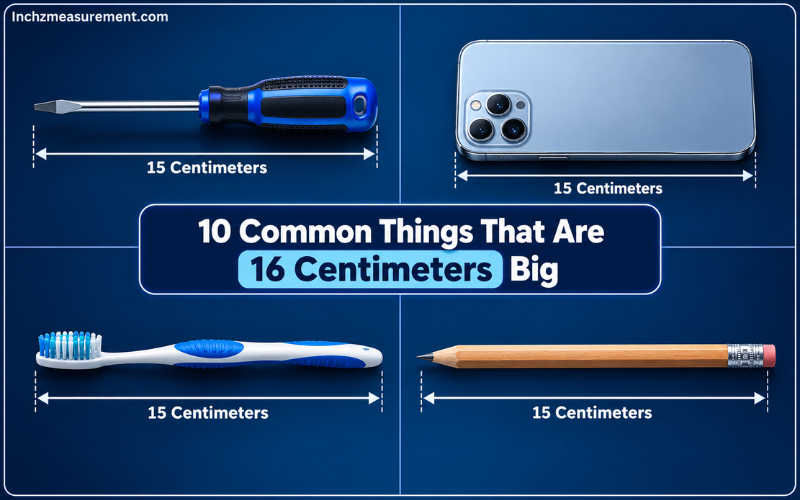
16 centimetres is 6.3 inches, or 160 millimetres. It is a little over half a foot and roughly the length of a small ruler. To picture 16 centimetres, imagine a standard 15-centimetre ruler with about 1 extra centimetre added to the end. The measurement is long enough to span much of an adult hand, but it is still small enough to fit comfortably inside a pocket or pencil case.
Real-life objects can make this size easier to visualise because many everyday items are close to 16 centimetres. The examples below include stationery, household items, tools and other familiar objects, with their sizes treated as approximate where manufacturers or designs vary.
[mzmeasure value=”16″ unit=”centimeters” example=”6-inch ruler”]
How Long Is 16 Centimeters?
Exactly 16 centimetres equals 160 millimetres and about 6.30 inches. In feet, it is approximately 0.52 feet. That makes 16 centimetres slightly longer than 6 inches, so it sits just above the length of a typical 6-inch ruler.
For a physical reference, a 6-inch ruler is 15.24 centimetres long, leaving a difference of only 0.76 centimetres compared with 16 centimetres. A standard A5 sheet of paper is also 14.8 centimetres wide, which is only 1.2 centimetres shorter.
These comparisons make 16 centimetres easier to judge without needing to imagine the metric scale by itself. You might encounter a measurement around this size in stationery, small tools, kitchen equipment and personal-care products.
Related Post: 10 Everyday Objects That Are About 13 Centimeters Big
[mztable value=”16″ unit=”Centimeters”]
How Big Is 16 Centimeters?
A length of 16 centimetres is roughly the distance from the tip of a person’s middle finger to a point near the base of the palm, although hand sizes differ considerably. It is also a little longer than a 6-inch ruler and about the width of a standard A5 sheet of paper.
If you have an A5 notebook, its shorter side measures 14.8 centimetres, so adding around 1.2 centimetres gives you a useful mental picture of 16 centimetres. Another simple comparison is six 1-inch segments plus about 0.3 inch. That is why 16 centimetres in inches is commonly rounded to 6.3 inches. For a rough estimate, placing a 6-inch ruler beside an object and allowing for roughly ¾ of an inch extra can help you judge whether something is close to 16 centimetres.
10 Common Things That Are 16 Centimeters Long
Many everyday objects fall close to 16 centimetres, although their dimensions can vary between brands and models. The table below focuses on objects that can provide a practical visual reference for this measurement.
| Everyday Item | Actual Size |
|---|---|
| 6-inch Ruler | 16 centimetres |
| A5 Notebook Short Side | 16 centimetres |
| Large Paintbrush | 16 centimetres |
| Crochet Hook | 16 centimetres |
| Small Kitchen Knife Blade | 16 centimetres |
| Wooden Pencil | 16 centimetres |
| Toothbrush | 16 centimetres |
| Small Hair Comb | 16 centimetres |
| Dinner Fork | 16 centimetres |
| Craft Scissors | 16 centimetres |
1. 6-inch Ruler
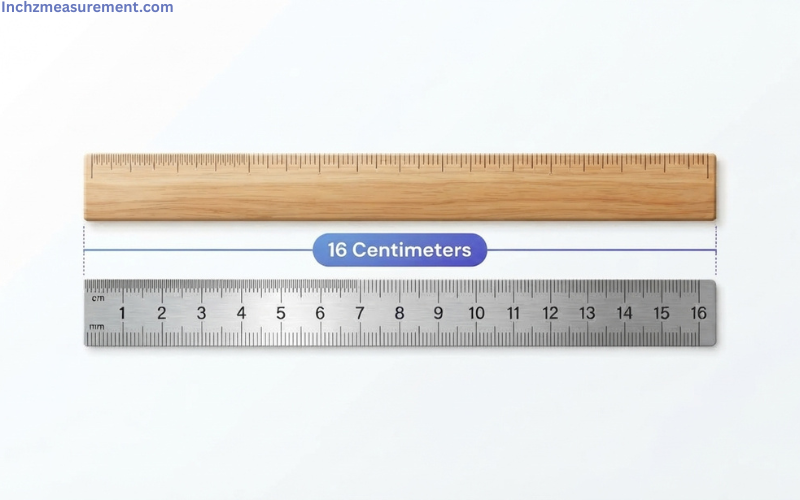
A 6-inch ruler is one of the easiest references for estimating 16 centimetres. The important detail is that a true 6-inch ruler measures 15.24 centimetres, so it is slightly shorter than the target. The difference is only 0.76 centimetres, however, which is less than the width of many pencil erasers.
If you place a 6-inch ruler next to an object and imagine roughly three-quarters of an inch added to its end, you have a close visual representation of 16 centimetres. Small rulers are common in pencil cases, desks and school supplies, so this comparison is particularly useful when estimating the measurement at home or at work. If you need an exact measurement, use the ruler itself rather than relying on the comparison.
2. A5 Notebook Short Side
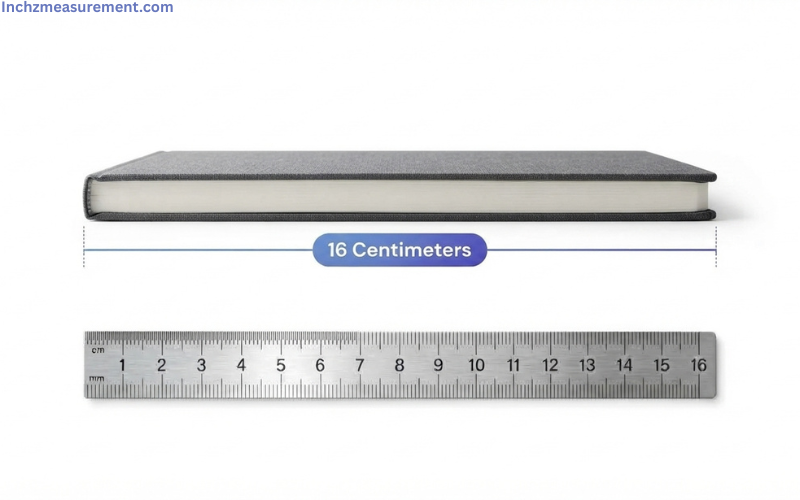
An A5 notebook measures 14.8 centimetres across its shorter side under the standard A5 paper dimensions. That makes it just 1.2 centimetres shorter than 16 centimetres. Because A5 notebooks are widely used for school, work and personal notes, they offer a convenient way to picture the target measurement.
Place an A5 notebook flat and look at its shorter edge. Imagine extending that edge by approximately 1.2 centimetres. The resulting length would be very close to 16 centimetres. This comparison is especially useful because the notebook provides a familiar rectangular reference rather than an abstract line. Keep in mind that covers can be slightly larger than the paper itself, so the physical outside dimensions of a particular notebook may differ.
3. Large Paintbrush
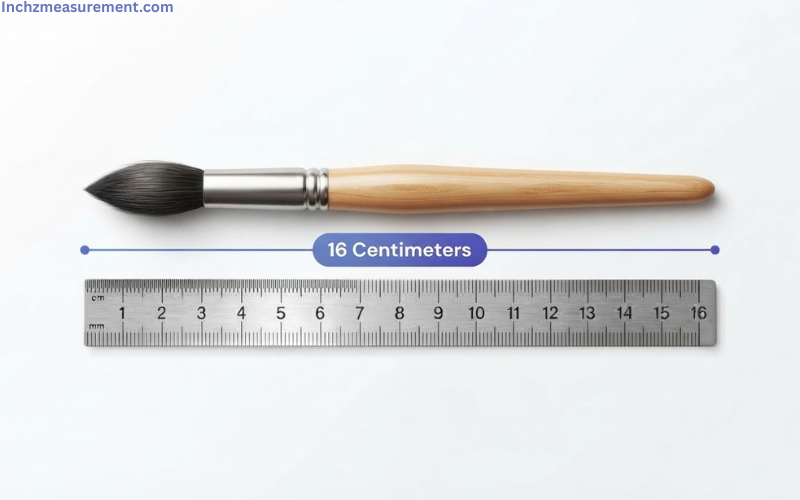
A large paintbrush can often provide a useful comparison for 16 centimetres, particularly when measuring from the end of the handle to the tip of the brush. Paintbrush designs vary significantly, so this should be treated as an approximate example rather than an exact standard.
A brush around 16 centimetres long is large enough for comfortable handling while remaining easy to store in a toolbox, drawer or craft box. You can picture the measurement by placing the brush alongside a 15-centimetre ruler and allowing approximately another centimetre beyond its end. Artist’s brushes, decorating brushes and craft brushes all come in different lengths, so checking the particular brush is necessary if precision matters.
4. Crochet Hook
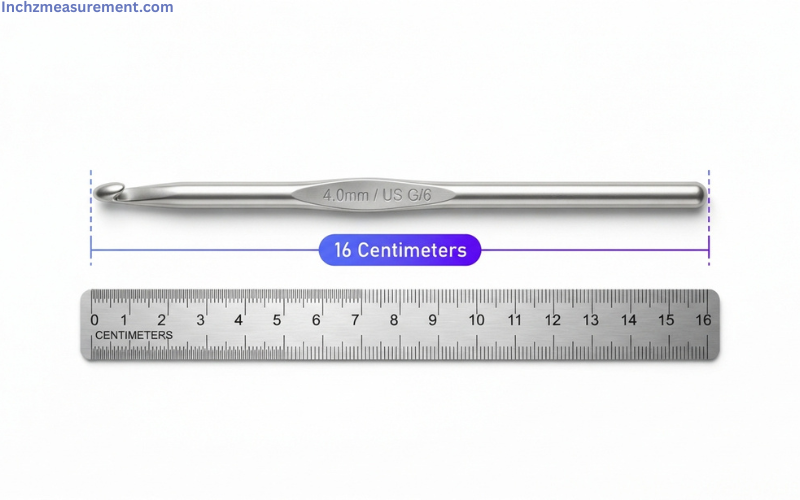
Some crochet hooks are around 16 centimetres long, making them another practical reference for this measurement. The exact length depends on the design, handle shape and manufacturer. Traditional hooks can be shorter or longer, while ergonomic versions often have thicker handles that change their overall appearance without necessarily changing the working length.
A 16-centimetre crochet hook is easy to visualise because it is a slim object with a clearly defined overall length. It would extend slightly beyond a standard 6-inch ruler. If you have several crochet hooks, comparing one with a ruler can also help you develop a better sense of what 16 centimetres looks like. This is an approximate comparison, not a universal crochet-hook specification.
5. Small Kitchen Knife Blade
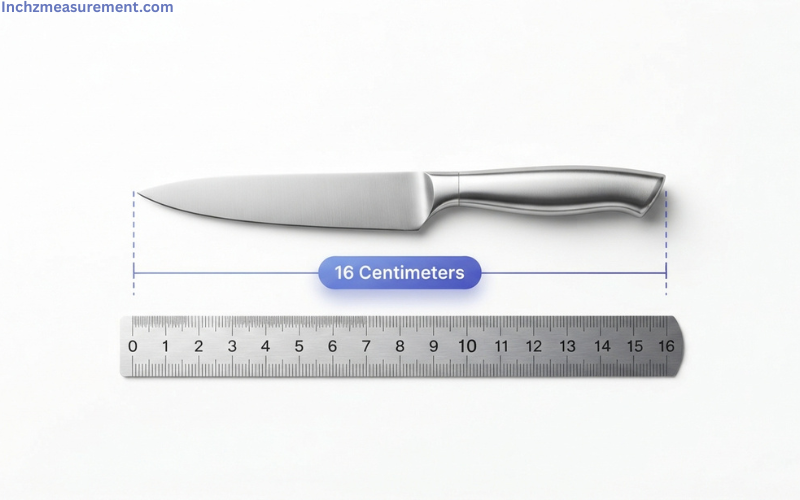
A small kitchen knife with a blade close to 16 centimetres provides a useful household comparison. Knife dimensions vary considerably, so the blade should be measured separately from the handle when comparing it with 16 centimetres. A small utility or kitchen knife may have a blade around this length, although some models are noticeably shorter or longer.
The blade length makes the measurement easy to picture because it forms a straight line from the heel of the blade to its tip. If the blade is approximately 16 centimetres, it would be just over 6.3 inches long. For safety, never use a knife as a measuring tool while handling it. If you need an accurate measurement, measure it safely with the knife secured and away from your hands, or use a ruler instead.
6. Wooden Pencil
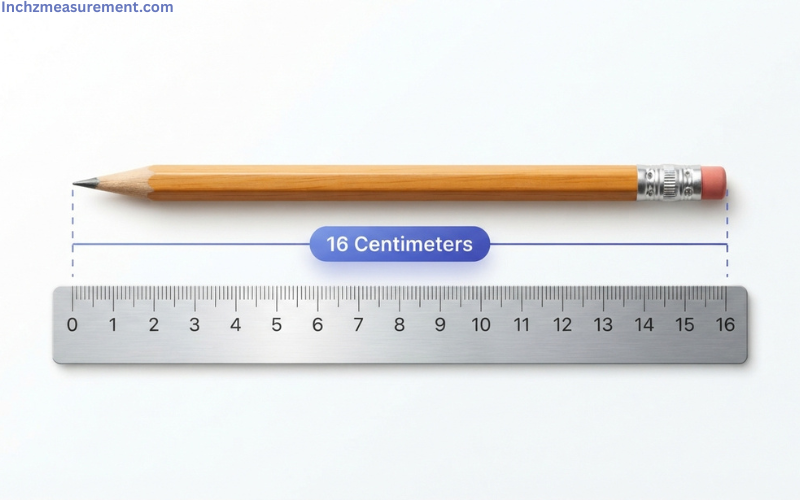
A wooden pencil can be surprisingly close to 16 centimetres, especially when comparing an unsharpened pencil or certain shorter pencil designs. Standard pencils are not all identical, and sharpening gradually reduces their overall length. This makes a pencil a useful visual reference but not a fixed 16-centimetre standard.
Imagine a pencil extending slightly beyond a 15-centimetre ruler. The extra section would be about 1 centimetre, giving you a close approximation of the target. A pencil also makes a good reference because it is narrow, straight and familiar. If you regularly use pencils, you can compare one with a ruler once and then use its approximate size as a mental reference when estimating other objects.
7. Toothbrush
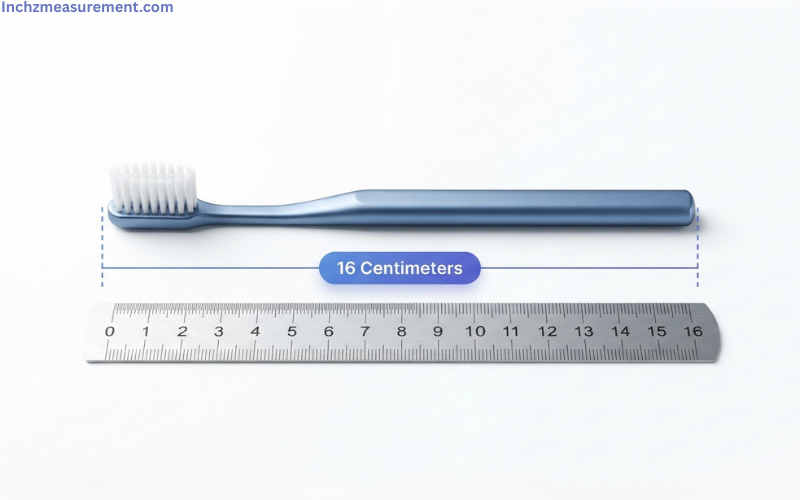
Some toothbrushes measure around 16 centimetres from the bottom of the handle to the tip of the brush head. However, toothbrushes come in many shapes and sizes, so their total lengths can differ by several centimetres. Children’s toothbrushes are usually shorter, while some adult designs have longer handles.
A toothbrush around 16 centimetres long gives you a familiar household comparison for how big 16 centimetres is. It is roughly the length of a small ruler plus a little extra. The straight handle also makes the overall size easy to compare visually. If you have a toothbrush available, placing it beside a ruler can show whether it is close to 16 centimetres. For hygiene reasons, use a clean ruler and avoid sharing measuring tools between personal-care items.
8. Small Hair Comb
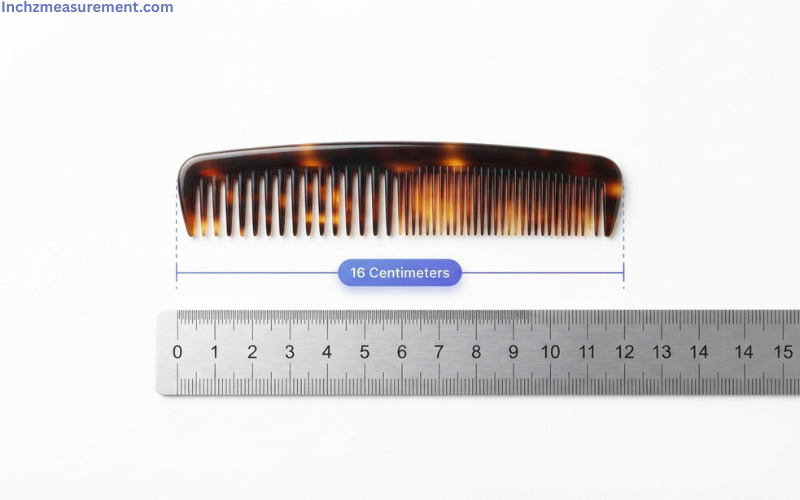
A compact hair comb can measure close to 16 centimetres from one end to the other. Pocket and travel combs vary widely, but some larger compact designs fall within this range. Their relatively straight shape makes them useful for visualising a measurement without complicated curves or irregular edges.
A comb measuring 16 centimetres would be about 6.3 inches long. That is slightly longer than a 6-inch ruler but still short enough to fit comfortably into many toiletry bags or drawers. The individual teeth can make the comb appear longer than it really is, so judge the measurement from the two outer ends rather than counting the teeth. As with other examples in this list, the exact size depends on the particular product.
9. Dinner Fork
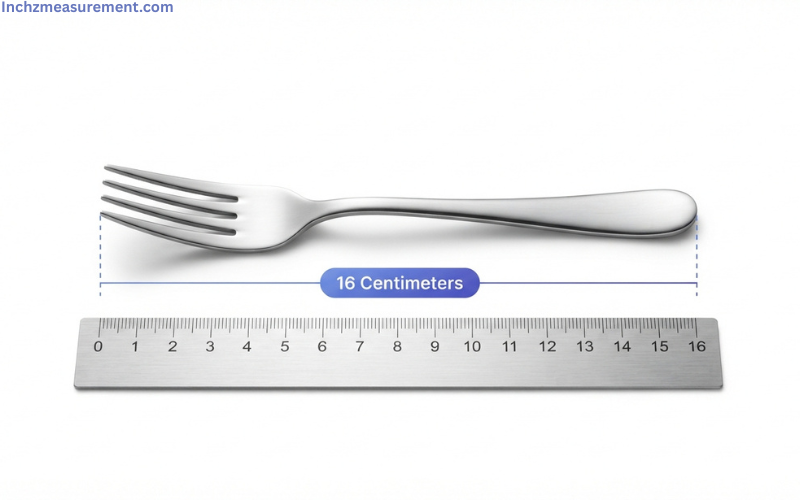
A dinner fork can sometimes be close to 16 centimetres long, although many full-sized table forks are longer. Smaller dining forks and some compact designs can fall around this measurement. The total length should be measured from the end of the handle to the tips of the tines.
The shape of a fork makes it an interesting comparison because its curved handle and narrow tines still create a fairly clear overall length. If you have a fork that measures approximately 16 centimetres, it gives you a useful kitchen-based reference for the target. Remember that cutlery is manufactured in many sizes, so it should not be treated as an exact standard. Measuring your particular fork will tell you whether it really reaches 16 centimetres.
10. Craft Scissors
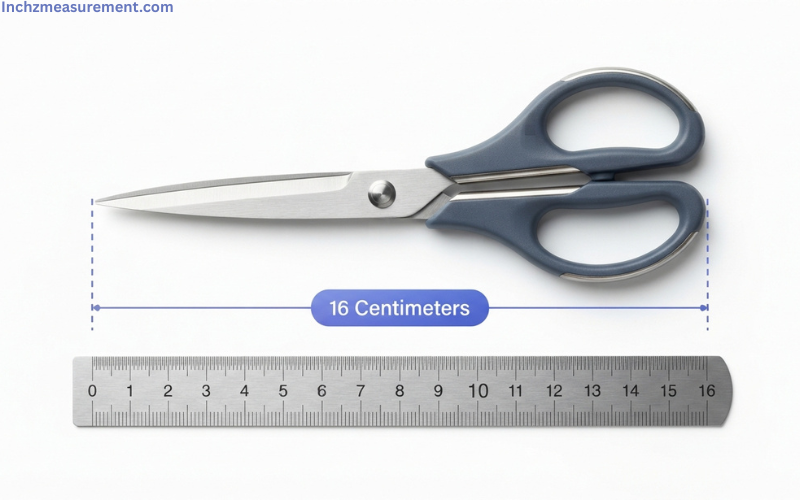
Small craft scissors can have an overall length close to 16 centimetres. Their size varies depending on the handle, blade and intended use, so some scissors will be considerably shorter or longer. A pair measuring around 16 centimetres is large enough for many everyday craft tasks while remaining compact enough for a stationery drawer.
To visualise the size, place the scissors closed on a flat surface and compare their full length with a 15-centimetre ruler. If the scissors extend by about 1 centimetre beyond the ruler, they are close to 16 centimetres. Measure from the back of the handle to the tip of the closed blades. For safety, keep scissors closed and pointed away from yourself while measuring them.
Measurement Without a Ruler
You can estimate 16 centimetres without a ruler by using familiar objects, but these methods will only give you an approximate result.
A 6-inch ruler is a particularly useful reference if you have one available. Since 6 inches equals 15.24 centimetres, you need only imagine about 0.76 centimetres more to reach 16 centimetres.
An A5 sheet of paper can also help. Its short side is 14.8 centimetres, so adding a little over 1 centimetre gives a close estimate. This works well because A5 paper has a standard size.
Your hand can provide another rough guide. The distance across or along parts of the hand differs from person to person, so do not treat it as an exact measuring instrument. A useful approach is to compare your hand with a known ruler first and then use that personal reference when estimating similar lengths.
FAQs
Is 16 centimetres the same as 6 inches?
No. Six inches equals exactly 15.24 centimetres. Sixteen centimetres is therefore 0.76 centimetres longer than 6 inches. In inches, 16 centimetres is approximately 6.30 inches. The difference is small, but it matters when an exact measurement is required.
How many inches are in 16 centimetres?
There are approximately 6.30 inches in 16 centimetres. The exact conversion is about 6.299 inches. For everyday measurements, 6.3 inches is usually a convenient rounded figure.
Is 16 centimetres a big measurement?
Sixteen centimetres is a relatively small everyday length. It is slightly longer than 6 inches and just over half a foot. A small ruler, pencil or compact household object can give you a useful visual idea of the size.
How many millimetres is 16 centimetres?
Sixteen centimetres equals 160 millimetres because each centimetre contains 10 millimetres. So, 16 × 10 = 160 mm. This conversion is exact and is useful when working with smaller measurements that require millimetre precision.
What does 16 centimetres look like?
Sixteen centimetres looks slightly longer than a 6-inch ruler. Another useful comparison is the short side of A5 paper, which is 14.8 centimetres. Adding about 1.2 centimetres to that side gives you a close visual representation of 16 centimetres.
Can I measure 16 centimetres with my hand?
You can estimate it, but your hand should not be considered an accurate measuring instrument. Hand sizes vary between people. Compare your hand with a ruler first if possible, then use the resulting personal reference to make a rough estimate.
Is 16 centimetres close to 1 foot?
It is not particularly close to a full foot. One foot equals 30.48 centimetres, so 16 centimetres is just over half a foot. More precisely, 16 centimetres is about 0.52 feet.
What common object is closest to 16 centimetres?
A 6-inch ruler is one of the simplest references because it measures 15.24 centimetres, which is only 0.76 centimetres shorter. An A5 sheet’s short side, at 14.8 centimetres, is another familiar comparison that is reasonably close to 16 centimetres.
Conclusion
Sixteen centimetres is equal to 160 millimetres or about 6.3 inches. A simple way to picture it is to take a 6-inch ruler, which is 15.24 centimetres long, and imagine roughly 0.76 centimetres added to its end. The short side of A5 paper is also close, measuring 14.8 centimetres.
Everyday objects such as pencils, toothbrushes, crochet hooks and small tools can provide additional visual references, although their exact dimensions vary. For a quick estimate, these comparisons can be useful. When accuracy matters, however, a ruler or tape measure remains the better choice.