
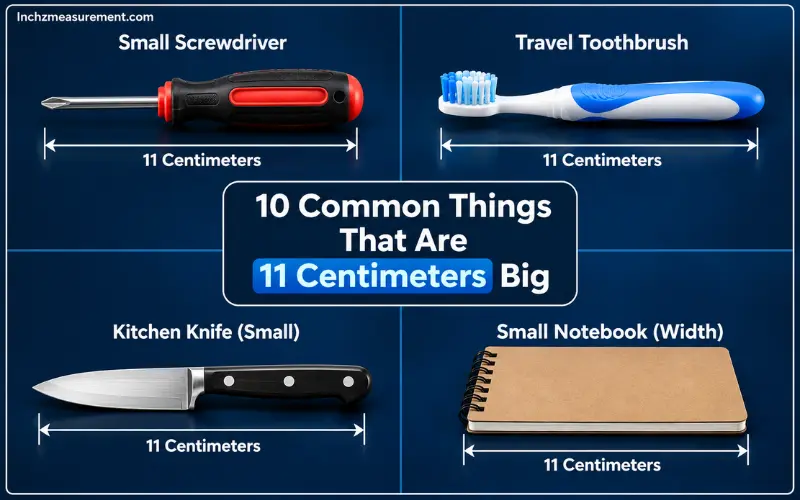
11 centimetres is equal to 4.33 inches or 110 millimetres. It is a fairly short length, roughly a little longer than the width of an adult hand and close to the length of some small household and stationery items. Because 11 cm is not a measurement people always have a ruler for, familiar objects can make it easier to picture. A small screwdriver, travel toothbrush, pencil stub, or short kitchen utensil may be close to this length. The exact size of these objects varies by design, so they should be treated as visual references rather than precise measuring tools.
[mzmeasure value=”11″ unit=”centimetres” example=”Small screwdriver”]
How Long Is 11 Centimetres?
11 centimetres measures exactly 110 millimetres. Converted to imperial units, it is approximately 4.33 inches, so it is a little more than 4 inches long. If you place a ruler beside an object, the 11 cm mark sits just past the 4-inch mark.
This measurement is useful for visualising small everyday objects. A compact screwdriver, a short section of a pencil, or a small kitchen utensil can sometimes come close to 11 cm. These comparisons are approximate because manufactured objects are rarely made to exactly the same dimensions.
For a quick mental reference, imagine a 10 cm ruler and add another centimetre. That extra centimetre is about the width of a fingernail for some adults, although finger and nail sizes differ.
[mztable value=”11″ unit=”Centimetres”]
How Big Is 11 Centimetres?
The easiest way to picture 11 cm is to think of something slightly longer than 4 inches. It is not a large measurement, but it is long enough to span several fingers placed together or cover much of a small stationery item.
An 11 cm length is about the same as 110 mm, which can look quite different depending on the object being measured. A thin item such as a screwdriver may look much longer than a thick object of the same length because its shape changes how we perceive it.
You can also compare it with a standard ruler. Start at zero and look at the 11 cm mark. The distance from the ruler’s edge to that mark gives a reliable picture of the measurement. If you do not have a ruler, several everyday objects below can provide a rough visual estimate.
Related Post: 11 Everyday Objects That Are About 12 Centimeters Big
10 Common Things That Are 11 Centimetres Long
The following objects can be found in sizes close to 11 cm. Some are deliberately made around this size, while others can vary depending on their design. The measurements are therefore useful for visualisation rather than precision measuring.
| Everyday Item | Actual Size |
| Small screwdriver | 11 centimetres |
| Travel toothbrush | 11 centimetres |
| Short kitchen knife blade | 11 centimetres |
| Small pencil or pencil stub | 11 centimetres |
| Compact candle | 11 centimetres |
| Small paintbrush | 11 centimetres |
| Craft scissors | 11 centimetres |
| Small notebook width | 11 centimetres |
| Short-handled kitchen utensil | 11 centimetres |
| Small wooden dowel | 11 centimetres |
1. Small Screwdriver
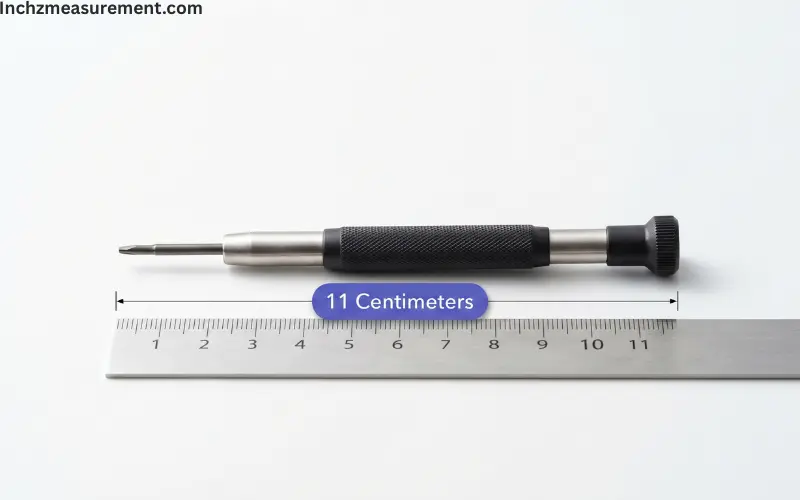
A compact screwdriver is a useful reference for 11 cm because many small hand tools have handles and shafts designed for tight spaces. Some short screwdrivers measure close to 11 cm from the end of the handle to the tip, although larger household screwdrivers can be considerably longer.
If you have a small screwdriver nearby, place it beside a ruler and check its total length. If it reaches approximately the 11 cm mark, you have a practical reference for this measurement.
The tool also helps because its length is easy to see in a straight line. Imagine an 11 cm screwdriver lying flat on a table. That gives you a much clearer sense of the measurement than simply hearing the number.
For an even simpler comparison, 11 cm is about 4.33 inches, so a screwdriver of this size would extend slightly beyond the 4-inch point on a ruler.
2. Travel Toothbrush
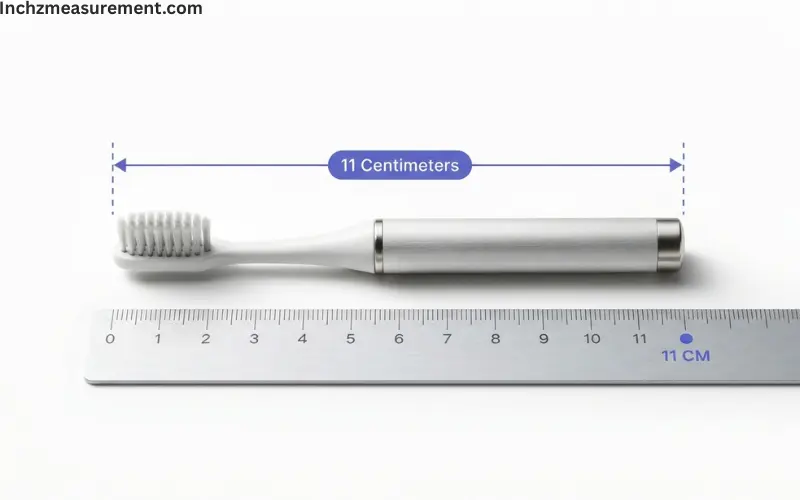
A compact travel toothbrush can sometimes be close to 11 cm long, particularly when it is designed for children, travel kits, or compact storage. Full-sized adult toothbrushes are normally longer, so the comparison should be treated as approximate.
A small toothbrush is useful for visualising 11 cm because it is a familiar object with a clearly defined beginning and end. If the handle measures around 11 cm, placing it beside a ruler shows almost exactly how far the measurement extends.
You can also use a travel toothbrush to compare the measurement with your hand. Depending on your hand size, the toothbrush may be similar to the distance across part of your palm and fingers.
If your toothbrush is longer than 11 cm, imagine removing the extra few centimetres from the handle. The remaining length gives a rough idea of what 11 cm looks like.
3. Short Kitchen Knife Blade
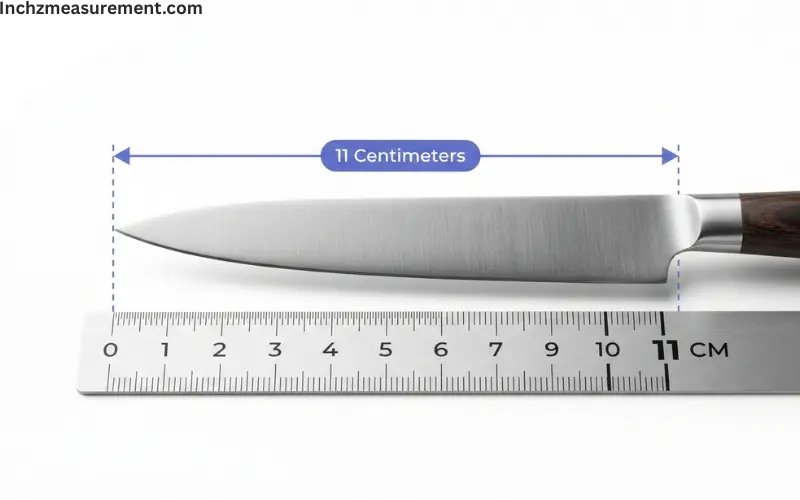
Some small kitchen knives have blades measuring around 10 to 12 cm. An 11 cm blade therefore provides a reasonable real-world comparison for the target measurement. Larger chef’s knives are much longer, so this comparison works best with a small utility or paring-style knife.
The blade should be measured from the point where the blade begins at the handle to its tip. The handle should not be included if you are comparing only the blade length.
An 11 cm blade is approximately 4.33 inches long. That makes it just over four inches from end to end. Seeing the blade beside a ruler can help you understand how modest this measurement is compared with a full kitchen knife.
For safety, never use a knife itself as a measuring tool by handling the blade unnecessarily. A ruler or a visual comparison with a safe object is a better option.
4. Small Pencil or Pencil Stub
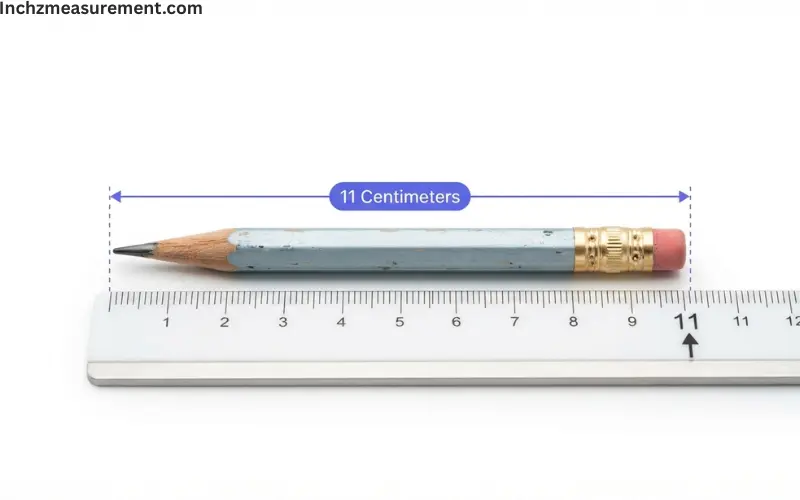
A standard new pencil is much longer than 11 cm, but a pencil that has been used for a while can become close to this measurement. A short pencil stub measuring about 11 cm provides a simple stationery-based comparison.
This example is especially useful because pencils are straight and easy to measure. Place the pencil on a flat surface and measure from one end to the other. If it reaches about 11 cm, it gives you a practical representation of the target length.
You can also imagine an ordinary pencil being divided into two sections. An 11 cm section is noticeably shorter than a new full-length pencil but still long enough to hold comfortably.
The exact size of pencils varies, and sharpening gradually reduces their length. That makes a short pencil a useful approximate comparison rather than a fixed standard.
5. Compact Candle
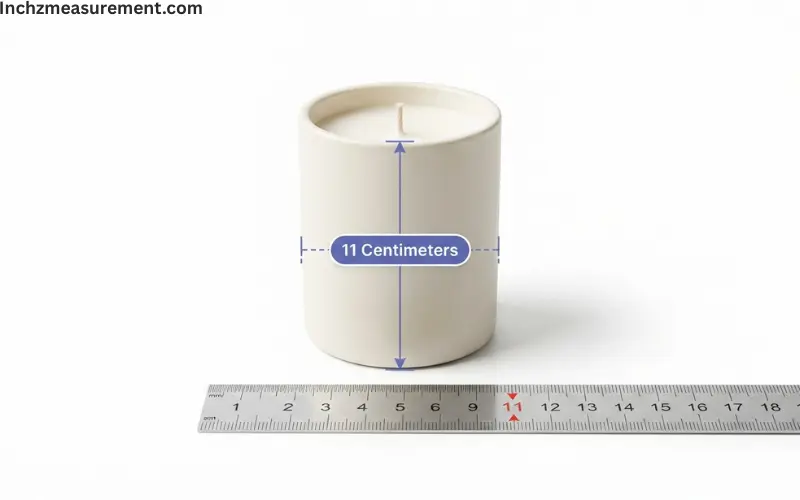
Some compact candles can measure close to 11 cm in height. Candle sizes vary widely, however, so not every candle will provide a suitable comparison. A small decorative or container-style candle may be around this height.
Imagine placing a candle upright next to a ruler. An 11 cm candle would reach just beyond the 10 cm mark. That extra centimetre is small but visible, helping you separate 10 cm from 11 cm.
The cylindrical shape of a candle also makes it easy to visualise the measurement vertically. You can picture a line running from the base to the top that is 110 mm long.
For comparison, 11 cm is about 4.33 inches. So a candle around this height would be slightly taller than a standard 4-inch object.
6. Small Paintbrush
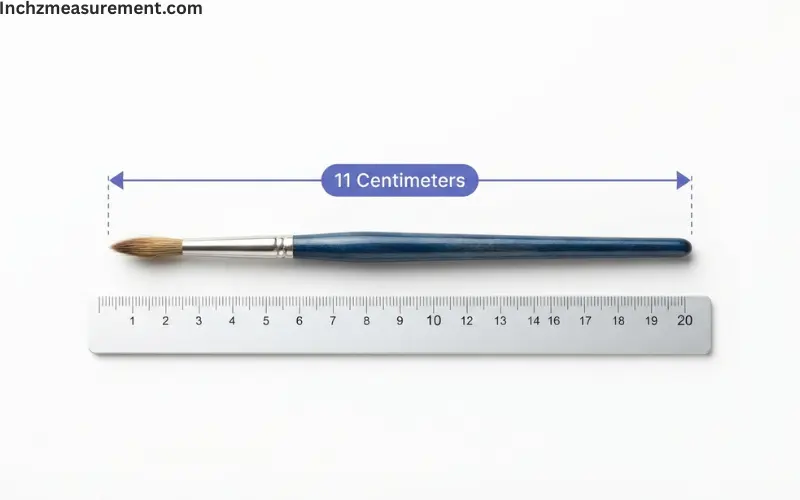
A small paintbrush can be close to 11 cm from the end of the handle to the tip of the bristles. Artist brushes come in many sizes, so this is an approximate comparison rather than a universal measurement.
A paintbrush is particularly useful because it is long, narrow and easy to place against a ruler. If the brush reaches around the 11 cm mark, it can give you a quick visual reference.
You can also estimate the measurement by comparing the brush with your fingers. Four inches is already a little longer than many people’s finger lengths, and 11 cm extends slightly beyond that.
If you are buying or cutting materials for a craft project, do not rely on a paintbrush as an exact measuring instrument. Use a ruler or tape measure for accurate work.
7. Craft Scissors
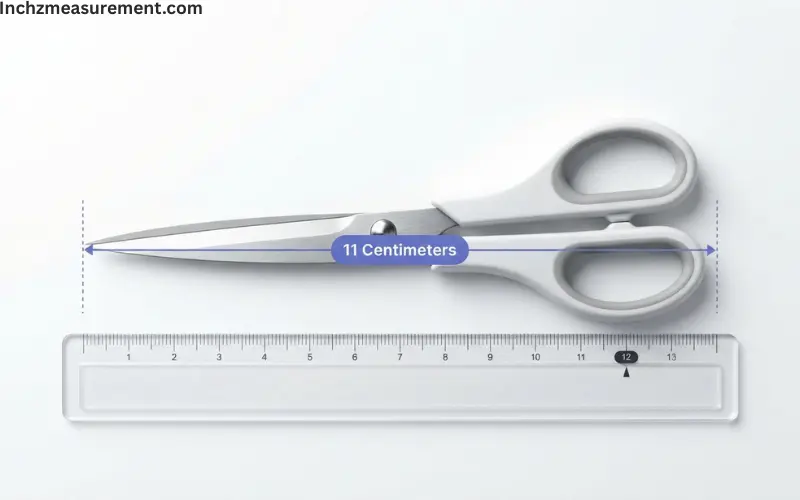
Small craft scissors may measure around 11 cm in total length. Children’s scissors, nail scissors and compact craft scissors can be particularly short, although their dimensions vary between designs.
To use them as a visual reference, place the closed scissors on a flat surface. Measure from the very end of one handle to the tip of the blades. If the total length is approximately 11 cm, you have an object that represents the measurement reasonably well.
The scissors also make it easy to compare 11 cm with 4 inches. Since 11 cm equals about 4.33 inches, the scissors would extend roughly one-third of an inch beyond the 4-inch mark.
Always keep scissors closed when using them for comparison and avoid treating them as a precision measuring device.
8. Small Notebook Width
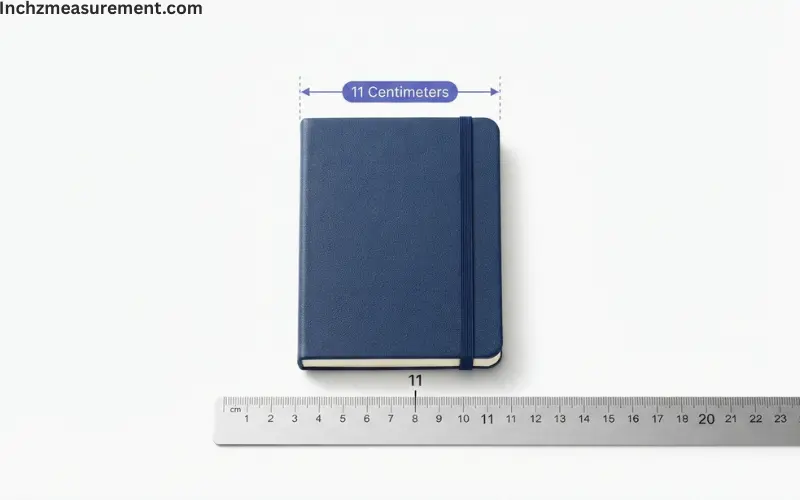
Some compact notebooks have a width close to 11 cm. Notebook dimensions vary significantly, but a small pocket notebook may have one side that falls near this measurement.
This comparison is useful because a notebook provides a broad, flat surface. Instead of looking at a thin line, you can see an entire 11 cm span across the cover.
If your notebook is slightly wider or narrower, the difference can still help you estimate the target. For example, if the notebook is 12 cm wide, 11 cm would be just 1 cm shorter. If it is 10 cm wide, adding another centimetre gives the target.
A notebook is also a convenient reference when estimating measurements for stationery, shelves, small boxes or craft projects.
9. Short-Handled Kitchen Utensil
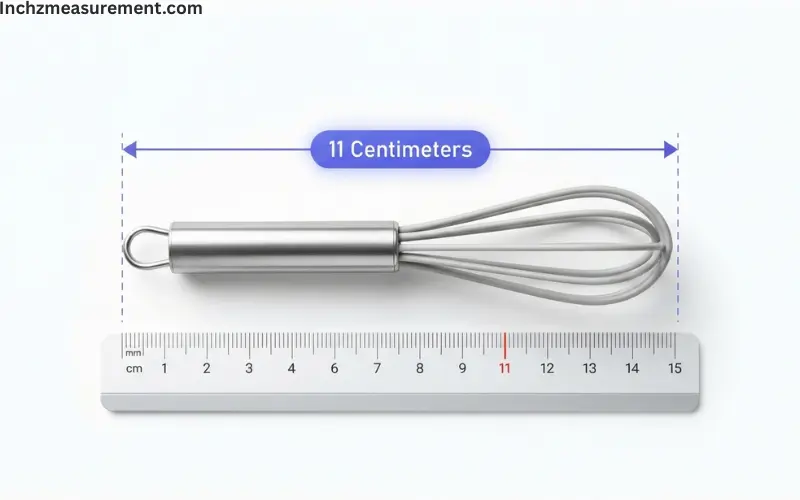
Small kitchen utensils can sometimes have handles or complete lengths close to 11 cm. Mini spatulas, tasting spoons, measuring tools and compact cooking utensils are examples where this size may occur.
The exact measurement depends heavily on the design. A full-size cooking spoon will normally be much longer, while a miniature utensil may be around the 11 cm range.
To visualise the target, imagine the utensil placed horizontally on a ruler. The end would reach 11 cm, which is 1 cm beyond the 10 cm mark and about 4.33 inches overall.
This is a useful comparison when thinking about small kitchen tools because many people already have them at home. Just remember that the object should be checked before being used as a measurement reference.
10. Small Wooden Dowel
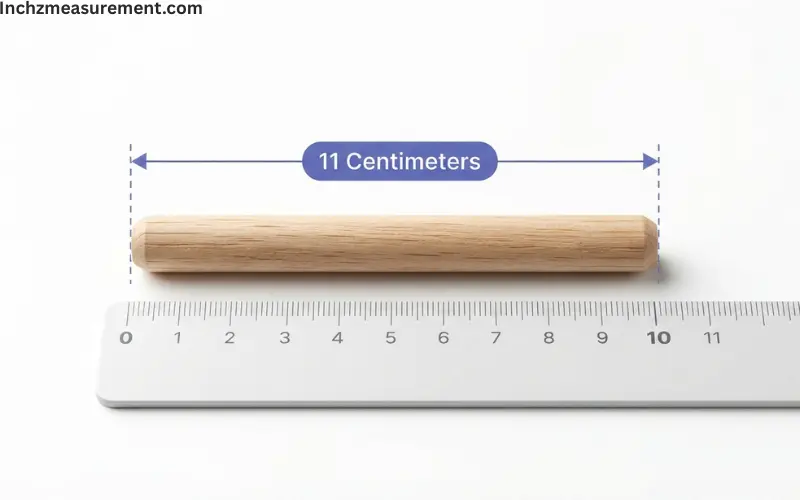
A short wooden dowel cut to 11 cm is another straightforward way to picture the measurement. Wooden dowels are commonly used in crafts, furniture projects and DIY work, and they can be cut to many different lengths.
Unlike naturally varying household objects, a dowel can be deliberately cut to an exact size. If you measure one to 11 cm, its straight shape gives you a clean representation of 110 mm.
Imagine holding the dowel horizontally. It would be slightly longer than 4 inches, but nowhere near as long as a standard 12-inch ruler.
This comparison can be especially useful for people working on craft projects. If a project calls for an 11 cm piece, marking 11 cm on a longer dowel and cutting at that point provides a much more reliable result than estimating by eye.
Measurement Without a Ruler
You can estimate 11 cm without a ruler, but these methods are only rough because body sizes and household objects vary.
One option is to use your hand. For some people, the width across four fingers placed together may approach 7–8 cm, so adding a little more distance can help you visualise 11 cm. Do not treat this as an exact measurement because hand sizes differ.
Another method is to use a known object. A standard bank card is about 8.56 cm wide, so 11 cm is roughly 2.4 cm longer than its width. This gives a useful visual comparison if you have a card available.
You can also use a 10 cm reference if you know one. Add roughly 1 cm to it. That small extra section is the difference between 10 cm and 11 cm.
For accurate work, a ruler or tape measure remains the better choice.
FAQs
Is 11 centimetres the same as 4 inches?
No. 11 centimetres is slightly longer than 4 inches. The exact conversion is approximately 4.33 inches. So, if you have a 4-inch object, an 11 cm object would extend about 0.33 inches beyond it.
How many millimetres are in 11 centimetres?
There are 110 millimetres in 11 centimetres. Since 1 centimetre equals 10 millimetres, multiplying 11 by 10 gives 110 mm.
How can I visualise 11 cm without a ruler?
You can compare it with a small notebook, compact screwdriver, travel toothbrush or another object that is known to be close to 11 cm. Body measurements such as fingers and hand spans can also help, but they are only rough estimates.
Is 11 cm considered a long measurement?
11 cm is a relatively short length. It is about 4.33 inches, so it is suitable for describing small tools, stationery, compact household objects and similar items. It is much shorter than a standard 12-inch ruler.
What does 11 cm look like compared with a 10 cm object?
An 11 cm object is only 1 cm longer than a 10 cm object. The difference is small but noticeable when the two are placed side by side. Think of 11 cm as a 10 cm length with an additional centimetre added to one end.
How many inches is 11 cm?
11 centimetres equals approximately 4.33 inches. It is therefore a little longer than 4 inches. If you are estimating the measurement using an inch-based ruler, look just past the 4-inch mark.
Can I use my hand to measure 11 cm?
You can use your hand for a rough estimate, but it will not be precise. Finger and hand dimensions differ from person to person. For an exact 11 cm measurement, use a ruler, measuring tape or another properly measured reference.
Is 11 cm close to the size of a small notebook?
Yes, some compact notebooks can have a width close to 11 cm. However, notebook dimensions vary considerably. Check the particular notebook before using it as a reference, especially when accuracy matters.
Conclusion
11 centimetres is a short but useful measurement equal to 110 mm or approximately 4.33 inches. A compact screwdriver, travel toothbrush, small paintbrush or short notebook can help you picture the size, although these objects should be treated as approximate references unless their dimensions have been measured.
The simplest mental image is a little more than 4 inches, or a 10 cm length with another centimetre added. If you need to estimate 11 cm without a ruler, compare it with a familiar object and remember that body-based measurements are only rough. For DIY, crafts or other tasks where precision matters, use a proper measuring tool.