
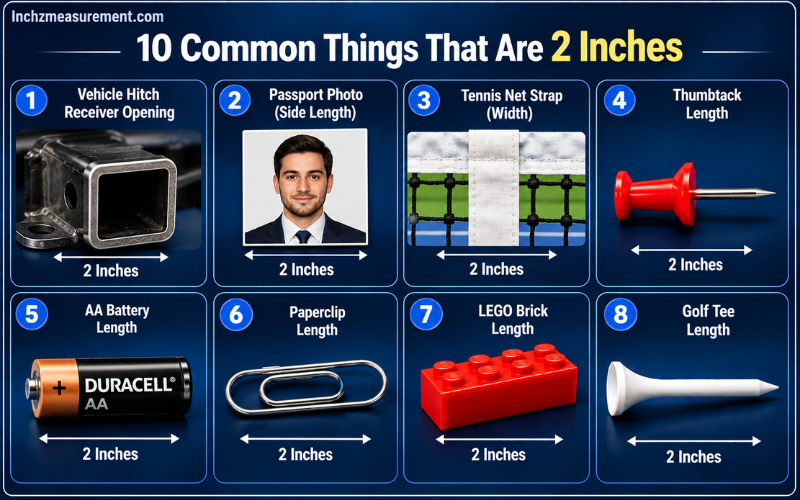
A small measurement can become surprisingly hard to picture when you are working on a home project. You may need to leave a 2-inch space, check a small opening, plan a fitting, or compare a measurement before buying materials. Looking at a number on paper does not always give you a strong sense of its physical size.
A real object or clearly defined dimension gives your eyes something concrete to remember. Two inches equals exactly 5.08 centimeters or 50.8 millimeters. Once you connect that length to familiar things, the measurement becomes much easier to recognize.
One correction matters for accuracy here: a full-size car, tree, building, or animal cannot honestly be described as an object that is exactly 2 inches long. Instead, the visual references below use real objects that have a documented 2-inch dimension. That keeps the comparisons useful without pretending that approximate objects are exact measurements.
How Long Is 2 Inches?
2 inches = 0.1667 feet
2 inches = 5.08 centimeters
2 inches = 0.0508 meters
2 inches = 0.0556 yards
2 inches = 50.8 millimeters
The exact conversion comes from the international definition of the inch: 1 inch equals 25.4 millimeters. Therefore, 2 inches equals 50.8 millimeters and 5.08 centimeters.
Conversion Table
| Unit | Exact equivalent |
| Inches | 2 in |
| Feet | 0.1667 ft |
| Centimeters | 5.08 cm |
| Millimeters | 50.8 mm |
| Meters | 0.0508 m |
| Yards | 0.0556 yd |
Metric measurements such as centimeters and millimeters are common in most countries, feet and inches remain common in the United States, and engineering work may switch between inches and millimeters when tighter dimensional precision is needed.
What Does 2 Inches Look Like?
Two inches is a short distance. Picture the distance from one end of a small 5.08-centimeter line to the other. It is shorter than the width of a standard credit card, whose width is 2.125 inches, but the difference is only 0.125 inch. That makes a credit card useful for visual scale, although it should not be labeled an exact 2-inch reference.
Indoors, 2 inches is easy to miss when looking across a room. A normal bedroom wall might measure 10 feet or more across, making 2 inches only a tiny fraction of that distance. On a tabletop, however, 2 inches becomes much more noticeable because the reference area is small.
If you walk at a normal pace of 3 miles per hour, you cover roughly 4.4 feet every second. Two inches is only 1/26.4 of that distance. Your eyes can still recognize it, but your feet are not a practical tool for directly walking a 2-inch distance.
10 Things That Are Exactly 2 Inches Long
The examples in this section follow one important rule: the specific dimension identified is exactly 2 inches. For larger objects, that does not mean the entire object is only 2 inches long.
1. A Standard 2-Inch Receiver Opening on a Vehicle Hitch
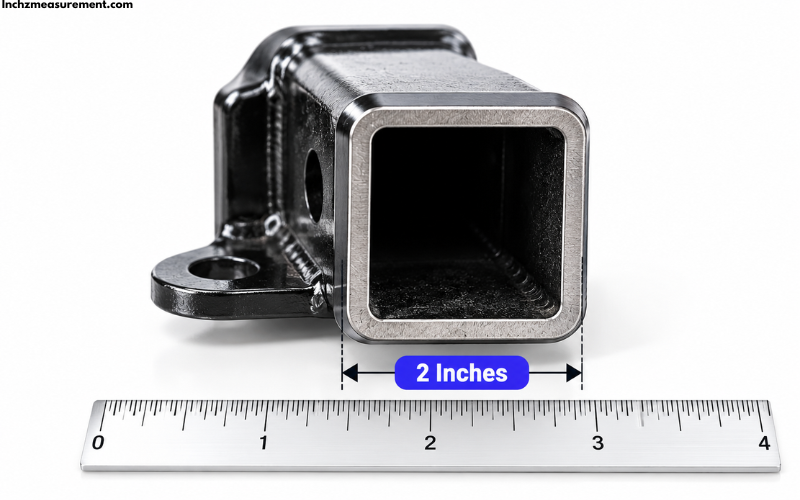
A Class III and IV style trailer hitch commonly uses a 2-inch square receiver opening. The 2-inch measurement refers to the inside size of the square receiver tube, not the length of the entire hitch.
You can see this feature on pickup trucks, SUVs, and other vehicles equipped for towing. It sits underneath the rear of the vehicle and accepts compatible hitch-mounted equipment.
Standing beside a pickup, the receiver looks surprisingly small compared with the vehicle itself. A 2-inch square opening is only 5.08 centimeters across, so it can disappear visually beneath a large bumper.
This is a useful reference because you can mentally separate the tiny 2-inch opening from the much larger vehicle around it. When someone asks, what object is 2 inches long, a vehicle hitch gives you a real-world reference with a defined 2-inch dimension rather than an estimated overall vehicle size.
The important point is that the receiver opening is the 2-inch measurement, not the truck or SUV itself.
2. A 2-Inch Passport Photo
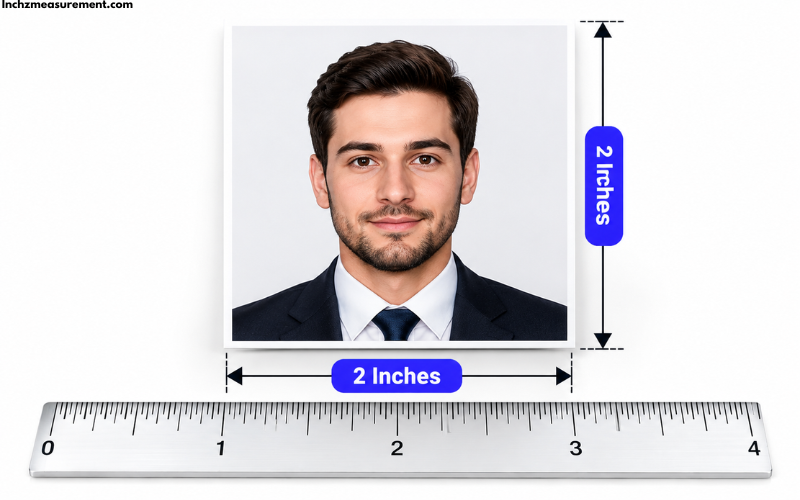
A U.S. passport photo is required to measure 2 inches by 2 inches. The U.S. Department of State specifies a square photograph measuring 2 × 2 inches, or 51 × 51 millimeters when rounded to the metric specification.
You see this size when preparing photographs for a U.S. passport application. It is also a familiar reference because the photograph is small enough to hold easily between your fingers.
Looking at the printed photo, each side gives you a direct visual representation of 2 inches. Unlike an ordinary photograph, its dimensions are controlled by an official requirement.
This makes a passport photo particularly useful for understanding how big is 2 inches. Put one on a desk and the horizontal edge is exactly 2 inches long.
It is one of the clearest examples because both dimensions of the square provide the same 2-inch reference.
3. A 2-Inch Tennis Net Strap
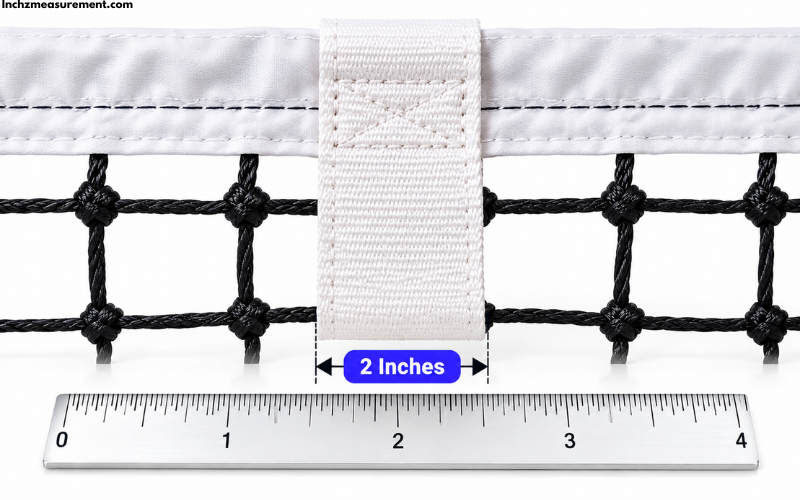
The International Tennis Federation specifies dimensions for the net and its components, including a net strap that is not more than 2 inches wide. This makes the 2-inch maximum width a useful sports reference, although an individual strap must be checked against its actual specification before being treated as an exact 2-inch object.
You see tennis net straps running vertically down the center of a tennis net. The strap helps hold the net at the required center height during play.
From beside the court, the strap looks narrow compared with the full 78-foot tennis court. Its width is only a tiny fraction of the court’s total length.
For visualizing 2 inches, the useful part is the defined maximum width rather than the entire net. It shows how a small 5.08-centimeter dimension can exist inside a much larger sports structure.
This gives you a practical 2 inch example from a familiar sporting environment, while keeping the measurement tied to a recognized specification.
4. A 2-Inch Engineering Dimension on a Scientific Instrument
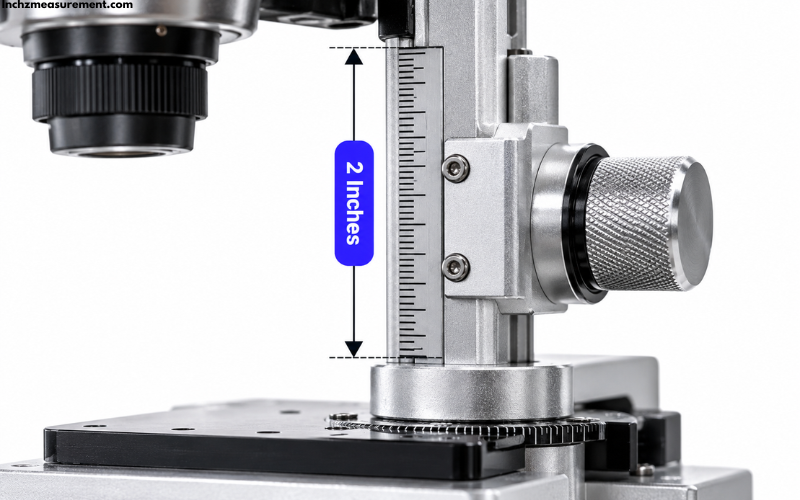
Scientific equipment can contain precisely defined 2-inch adjustment ranges. For example, a National Institute of Standards and Technology publication describing a rheometer at the NIST Center for Neutron Research records a vertical adjustment of 50.8 millimeters, or 2 inches.
You would see equipment like this inside a scientific laboratory rather than a typical home. The measurement is part of the instrument’s physical setup and adjustment system.
Standing beside laboratory equipment makes 2 inches look very small. The instrument itself can be much larger, while a 2-inch adjustment represents a clearly defined physical movement.
This is a good reminder that 2 inches is not merely an everyday household measurement. It also appears as a precise engineering dimension in scientific hardware.
If you need a technically documented 2-inch reference, this example is stronger than claiming that an arbitrary household object is exactly 2 inches long.
5. A 2-Inch Handle Dimension on a Drain Pan
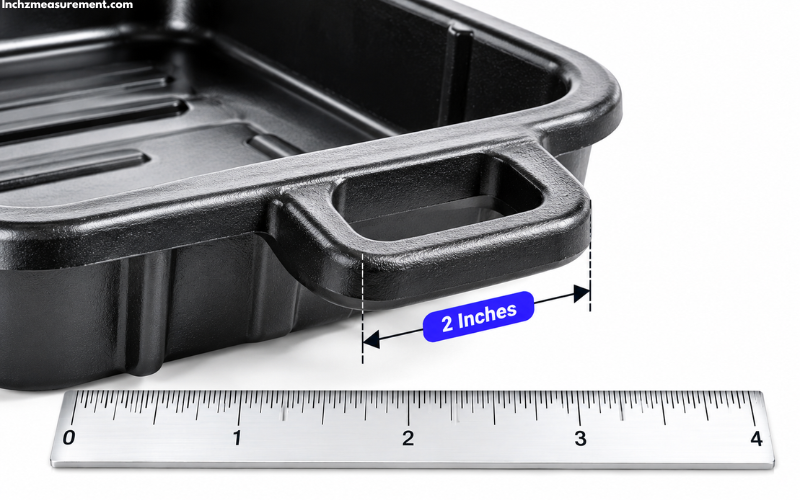
A National Institute of Standards and Technology-related government specification for a drain pan includes a handle detail with a 2-inch dimension. The drawing identifies a 50.8-millimeter, or 2-inch, measurement in the handle assembly.
This type of drain pan is used in technical and food-service-related environments where equipment needs controlled drainage and cleaning. The pan itself is much larger than 2 inches.
When you look at the complete pan, the 2-inch section appears small. That contrast can actually make the measurement easier to understand because your eyes can compare the tiny dimension with the larger 18-inch pan.
The key visual is the specified 2-inch portion of the handle detail. It gives you a real physical feature with an engineering dimension instead of relying on an estimated object size.
So, when you ask how long is 2 inches, a documented 50.8-millimeter feature provides a much safer reference than a random object advertised as “about two inches.”
6. A 2-Inch Marked Adjustment on Laboratory Equipment
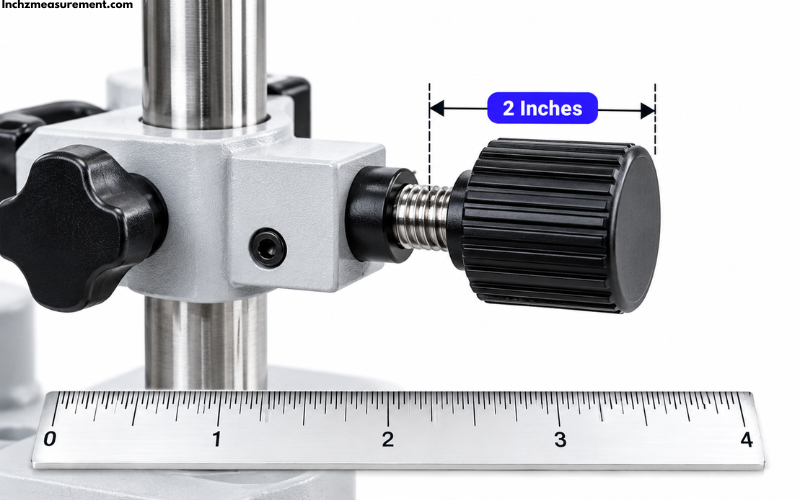
Precision laboratory equipment provides another useful way to picture 2 inches because measurements are often written directly into technical drawings. A documented instrument specification can identify a 50.8-millimeter adjustment, which is exactly 2 inches.
You would find this kind of measurement in laboratories, research facilities, universities, and industrial testing environments. Technicians use dimensional specifications when setting up equipment rather than relying on visual guesses.
Standing next to a laboratory instrument gives you an interesting sense of scale. A two-inch movement may seem insignificant beside the entire machine, yet it can matter greatly to how the equipment operates.
That is one reason engineering drawings are useful when explaining how big is 2 inches. They show that the measurement can be a precise working dimension inside a much larger structure.
A documented 50.8-millimeter adjustment therefore makes a more defensible 2-inch reference than an ordinary product whose size changes from one manufacturer to another.
7. A 2-Inch Construction Detail
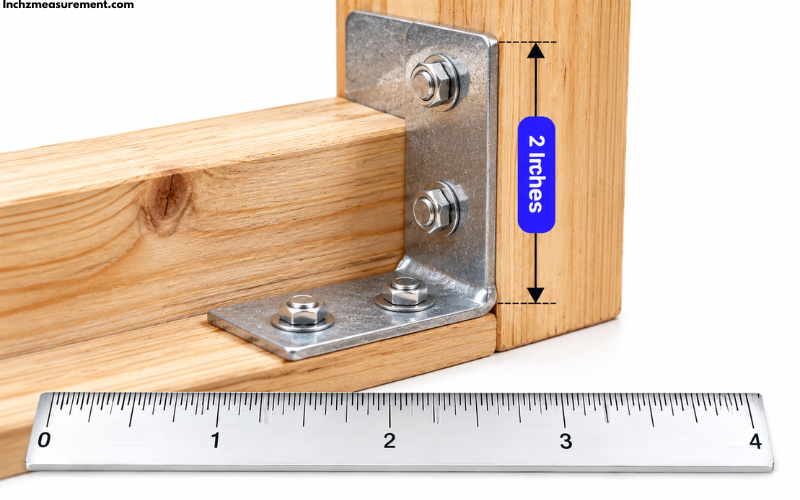
Construction drawings frequently use inch-based dimensions for individual parts of walls, handles, openings, supports, and other structural details. A government-published drain-pan specification, for example, identifies several dimensions of 50.8 millimeters, or 2 inches.
You can encounter this kind of dimension in architectural drawings, engineering plans, fabrication drawings, and construction specifications. The full structure can be many feet long while individual details are measured in inches.
Standing beside a building makes 2 inches look extremely small. A two-inch feature could disappear into a much larger wall or frame unless you place a ruler beside it.
That contrast is useful when learning the difference between a small linear measurement and the overall size of an object. Two inches is only one-sixth of a foot, so it occupies a very small part of a typical building dimension.
For a dependable 2 inch example, use the documented feature rather than claiming that an entire building component has a universal 2-inch length.
8. A 2-Inch Adjustment in a Scientific Laboratory
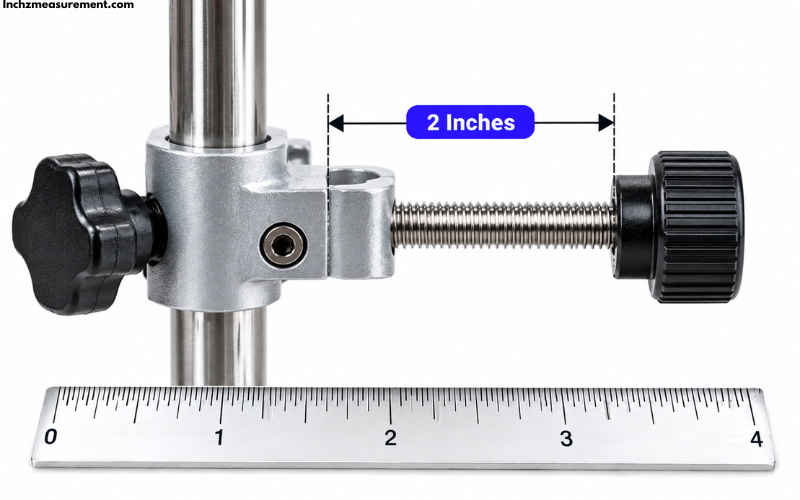
A second laboratory reference can help because precision equipment often has multiple small adjustment dimensions. The NIST-published rheometer documentation specifically records a 50.8-millimeter adjustment range, which converts exactly to 2 inches.
You would see this kind of equipment on a laboratory bench, inside a research facility, or at a scientific testing center. Unlike a household object, its dimensions are recorded as part of the equipment’s technical specifications.
A 2-inch adjustment looks tiny when the entire machine is in front of you. You can hold your fingers 5.08 centimeters apart and compare that gap with the documented movement.
This creates a useful mental picture: 2 inches is large enough to see clearly on a small component but small enough to become insignificant beside a full laboratory setup.
That makes technical equipment a strong visual lesson for how tall is 2 inches and how much physical space a 50.8-millimeter movement actually occupies.
9. A 2-Inch Drain-Pan Handle Detail
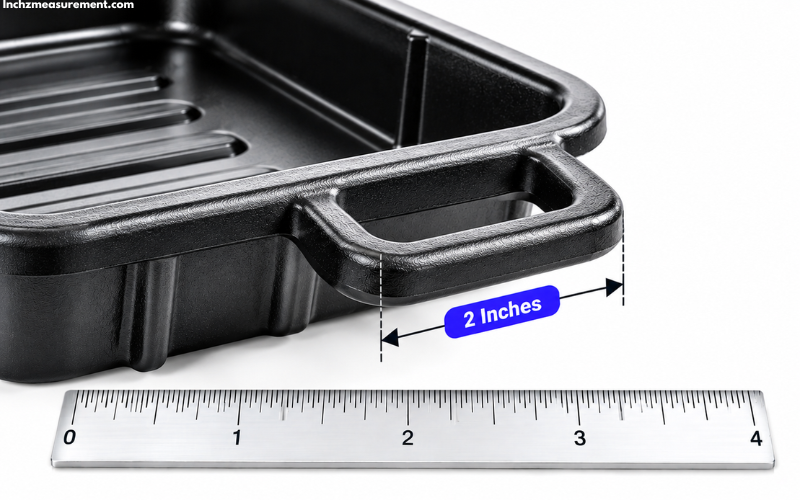
Another documented 2-inch reference appears in the handle details of a government-published drain-pan specification. The drawing identifies a 50.8-millimeter, or 2-inch, dimension associated with the handle construction.
This kind of equipment is encountered in commercial, industrial, and food-handling environments rather than in a normal living room. The overall pan has dimensions far larger than two inches, giving you a useful scale contrast.
If you stood beside the finished pan, the 2-inch dimension would feel quite small. You could fit 12 such lengths into 24 inches, while the pan itself spans much more space.
The example demonstrates why technical drawings can be better than vague everyday comparisons. The 2-inch measurement is written as a defined specification rather than estimated from a photograph.
For anyone searching what object is 2 inches long, the safest answer is often a precisely specified part or dimension rather than an entire object that merely looks close to 2 inches.
10. A 2-Inch Receiver Dimension Compared With a Full-Size Vehicle
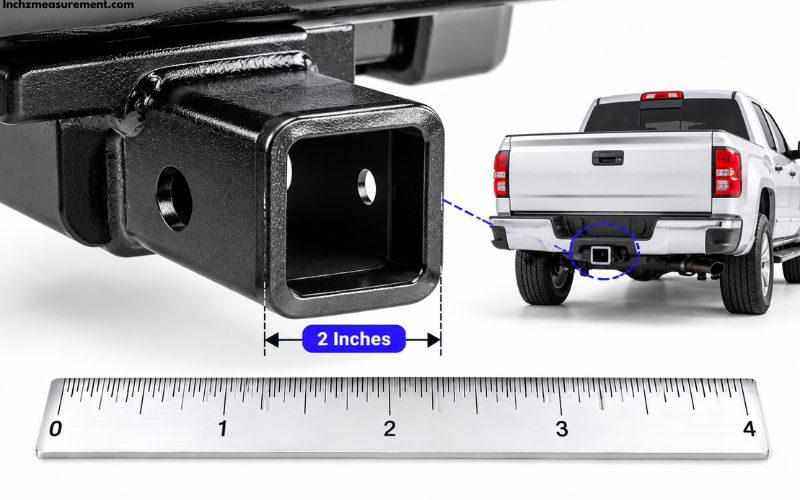
A 2-inch vehicle-hitch receiver provides one of the easiest large-scale visual comparisons. The receiver opening is a compact 2-inch square dimension mounted on a much larger vehicle.
You can find this type of hitch beneath many pickup trucks and SUVs used for towing trailers or carrying hitch-mounted accessories. The vehicle may be more than 15 feet long, yet the receiver opening measures only 2 inches across.
Standing behind the vehicle makes the scale difference obvious. A 2-inch opening is tiny compared with a bumper, tailgate, rear tire, or truck bed.
This is useful when someone asks how big is 2 inches because your brain can compare the small opening with a familiar large object. The contrast makes the measurement easier to remember.
Remember that the exact 2-inch reference is the receiver opening, not the entire vehicle. That distinction keeps the measurement accurate.
How Big Is 2 Inches?
Indoors, 2 inches is a small but noticeable distance when you look at a nearby surface. On a kitchen counter, for example, a 2-inch gap is easy to see if you place it beside a plate, utensil, or sheet of paper. Across a living-room wall, the same 2 inches becomes almost invisible because the surrounding space is so large.
A useful mental picture is a small square measuring 2 inches by 2 inches. That square has an area of 4 square inches. A U.S. passport photo uses this exact 2-by-2-inch format, giving you a real object that can be held in your hand and viewed from several angles.
Outdoors, the same 2-inch distance looks even smaller. Compare it with a driveway that is 20 feet wide. Twenty feet equals 240 inches, so 2 inches represents only 1/120 of that width. The measurement becomes easier to appreciate when you shrink the comparison down to a nearby edge, crack, joint, or marked feature.
How Tall Is 2 Inches?
Vertically, 2 inches is only 5.08 centimeters. Hold your hand upright and imagine a small vertical line extending from the bottom to the top of a 2-inch square. It is far shorter than a stair riser and tiny compared with a doorway.
Now compare it with a building. A modest two-story house can have a total height of roughly 20 feet or more, while 2 inches equals only 1/120 of 20 feet. A 2-inch vertical feature would therefore occupy a tiny fraction of the building’s height.
Trees create an even stronger contrast. A 20-foot tree has 240 inches of vertical height. A 2-inch segment is just 1/120 of that height, so the difference between a 2-inch measurement and a full-size tree is enormous.
How Far Is 2 Inches?
Two inches is a very short horizontal distance. At a normal walking speed of 3 miles per hour, a person travels 264 feet per minute, or 4.4 feet per second. Since 2 inches is 1/26.4 of a foot, it would take only about 0.014 seconds to cover that distance at a constant 3-mph pace.
You cannot realistically count a walking step for only 2 inches because one normal walking step covers far more distance. If your stride is 2.5 feet, then 2 inches represents only 1/15 of one stride. Think of it as a tiny fraction of the distance between two ordinary footprints rather than a complete step.
2 Inches Comparison Table
| Comparison | Difference | Real-world visual |
| 2 inches vs 1 inch | 1 inch | The difference equals the length of a 1-inch segment on a ruler. |
| 2 inches vs 3 inches | 1 inch | The extra inch is the same length as the first inch on a standard ruler. |
| 2 inches vs 4 inches | 2 inches | The difference is another complete 2-inch passport-photo edge. |
| 2 inches vs 1 foot | 10 inches | The missing 10 inches is longer than a standard 8-inch sheet of paper’s width. |
| 2 inches vs 2 feet | 22 inches | The difference is longer than a standard 18-inch school ruler. |
| 2 inches vs 4 feet | 46 inches | The difference is nearly the full height of a 48-inch countertop-height reference. |
The biggest lesson is scale. Two inches becomes easier to knowing when you compare it with a second measurement that has a familiar physical object attached to it.
How to Measure 2 Inches Without a Tape Measure
Method 1 — Using Your Steps
Your normal walking stride is far too large to measure 2 inches directly, so first calibrate it. Walk 10 normal steps across a flat surface and measure the total distance later with a ruler or known reference. If those 10 steps cover 25 feet, your average stride is 2.5 feet.
Now convert 2 inches into feet: 2 inches equals 0.1667 feet. Divide 0.1667 by your 2.5-foot stride. The result is about 0.067 of a stride. In other words, 2 inches is only about one-fifteenth of a normal 2.5-foot stride.
This method is best for understanding scale rather than physically walking the exact distance. You can also place your foot down, estimate one stride, and visually divide that stride into 15 equal sections. One of those sections gives you a rough visual impression of 2 inches.
Method 2 — Using Floor Tiles
Floor tiles can provide a better stationary reference. First identify the tile’s actual dimensions. Common square tiles include 12 × 12 inches, 18 × 18 inches, and 24 × 24 inches, but you should check the marked size rather than assuming.
Suppose you have a 12-inch tile. Two inches equals exactly one-sixth of its side. Look at one edge and mentally divide it into six equal sections. One section represents 2 inches.
For a 24-inch tile, divide the edge into 12 equal sections. Again, one section represents exactly 2 inches. Watch the grout lines because they can add extra space and make the visual estimate inaccurate.
This technique works particularly well on a clean, square tile because the full dimension is known. It turns a large surface into a simple visual ruler.
Related Post: How Long Is 1 Inch? 10 Things Exactly 1 Inch Long
Method 3 — Using Your Body
Your body can provide a convenient visual reference, but unlike a manufactured standard, body dimensions vary from person to person. The safest method is to calibrate your own hand once.
Measure the width of your thumb or the distance between two points on your hand using a ruler. If your measured reference is 1 inch, place that reference twice end to end. Two 1-inch sections give you exactly 2 inches.
You can also use your own height as a proportional reference. For example, a person who is 5 feet 10 inches tall has a total height of 70 inches. Two inches represents 2/70 of that height, or 1/35.
The key is calibration. Do not assume every adult thumb or finger has the same size. Once you know your personal measurement, however, your hand becomes a convenient reference when you need to estimate how long is 2 inches without carrying a ruler.
FAQ
Q1: How long is 2 inches in meters?
Two inches equals exactly 0.0508 meters. The same length is 5.08 centimeters or 50.8 millimeters.
Q2: How many steps is 2 inches?
Two inches is not a complete normal walking step. With a 2.5-foot stride, 2 inches equals about 0.067 of one stride, or roughly one-fifteenth of a step.
Q3: How tall is 2 inches compared to a house?
Two inches is extremely small compared with a house. If a two-story house is 20 feet tall, it measures 240 inches, so 2 inches represents only 1/120 of that height.
Q4: Is 2 inches bigger than a school bus?
No. A full-size school bus is many feet long, while 2 inches equals only 0.1667 feet. Even a 20-foot bus would be 120 times longer than 2 inches.
Q5: How long does it take to walk 2 inches?
At a constant walking speed of 3 mph, 2 inches would take about 0.014 seconds to cover. That is far too short to register as a normal walking step, since one ordinary stride covers several feet.
Conclusion
The clearest way to remember 2 inches is to use a precisely defined small dimension rather than an object that merely looks close. A 2 × 2-inch passport photo gives you a particularly easy visual reference, while a 2-inch vehicle hitch receiver shows how the same measurement can appear as a small feature on a much larger object. Technical specifications also demonstrate that 50.8 millimeters can be an exact working dimension in real equipment.
Bookmark this page if you regularly work with small measurements. The next time you need to picture how long is 2 inches, remember the exact conversion: 2 inches = 5.08 cm = 50.8 mm. For precision work, use a ruler or caliper; for quick visual planning, use a calibrated reference you already understand.